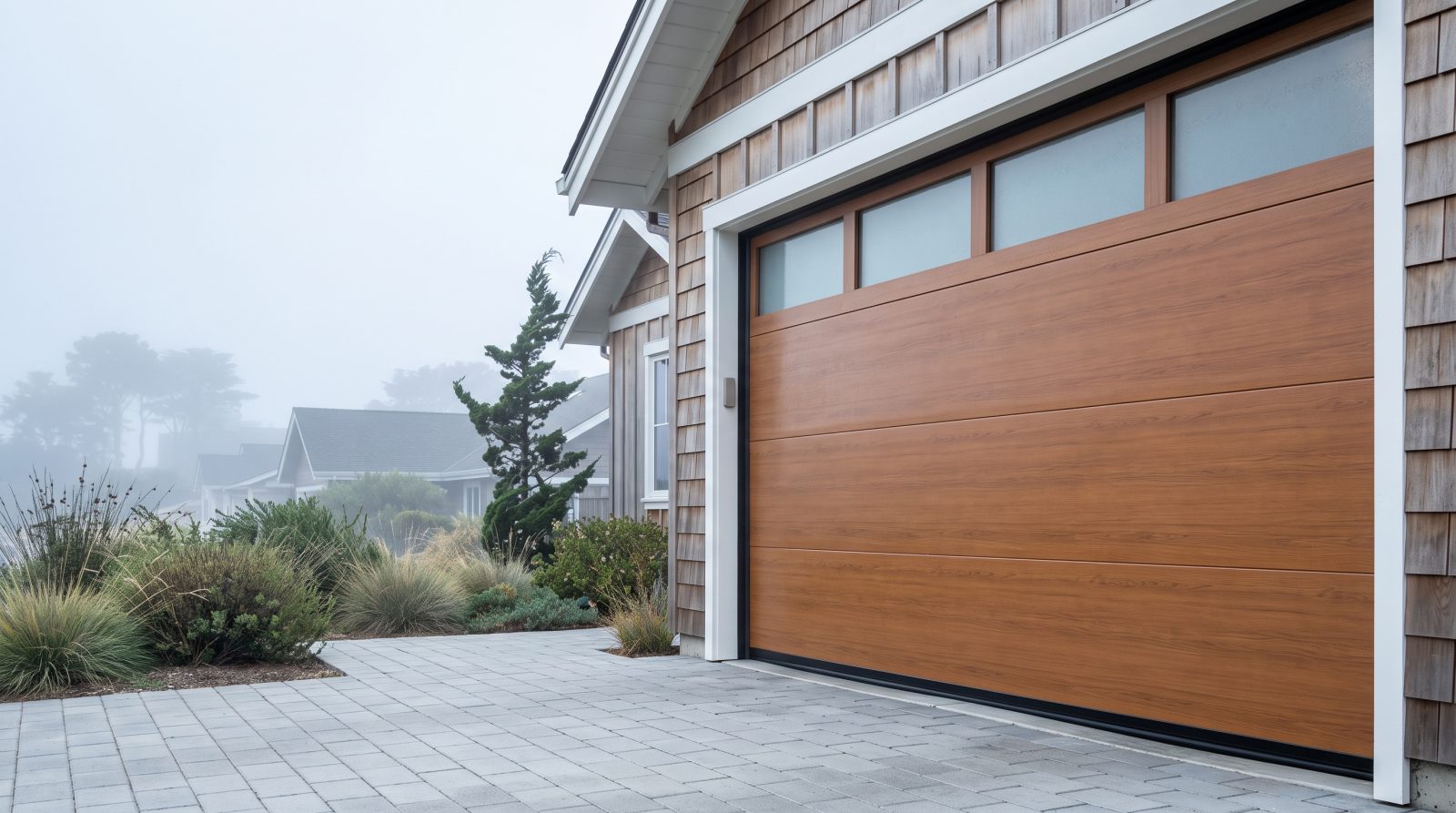
What a Fiberglass Garage Door Actually Is
The phrase "fiberglass garage door" is slightly misleading, because almost no door is solid fiberglass. What you are really buying is a layered system: fiberglass-reinforced panels (often called FRP, fiberglass-reinforced polymer) bonded to a frame, usually with a foam insulation core sandwiched in the middle and a metal or composite perimeter for structural rigidity. The fiberglass skin is the part that faces the weather, and it is the reason these doors behave so differently from steel or wood.
Because the visible surface is a molded polymer rather than a painted metal sheet, manufacturers can press realistic wood-grain texture directly into it. That is the main reason homeowners shop for fiberglass in the first place: from the curb, a well-made fiberglass door can read as stained cedar or mahogany while weighing a fraction of what a real wood door does and asking for far less upkeep. The panels are typically translucent enough that some models can be lit from inside for a soft glow, though most Bay Area buyers choose opaque, stained-look finishes.
It helps to think of fiberglass as occupying the middle ground between steel and wood. Steel is the workhorse: affordable, strong, low-maintenance, but vulnerable to rust and easy to dent. Wood is beautiful and substantial but heavy, expensive, and demanding in a damp climate. Fiberglass tries to capture wood's look and steel's low maintenance while dodging the worst weaknesses of both. Whether it succeeds depends a lot on where your home sits.
- Skin: molded fiberglass-reinforced polymer, often wood-grain textured
- Core: most quality doors are insulated with polyurethane or polystyrene foam
- Frame: composite or metal perimeter and stiles for rigidity
- Finish: factory-applied stain or paint-look color, not bare material
Why Fiberglass Makes Sense Near the Bay Area Coast
The single strongest argument for fiberglass in our region is corrosion resistance. Salt-laden marine air is relentless on the western and bay-facing edges of the region. In neighborhoods like Pacifica's Sharp Park, the Outer Sunset and Richmond districts of San Francisco, Alameda's shoreline streets, and the coastal stretch from Montara down to Half Moon Bay, steel doors can show surface rust at cut edges, fasteners, and seams faster than homeowners expect. Fiberglass panels simply do not rust, because there is no exposed steel skin to oxidize. That alone can be decisive within a few blocks of the water.
Fiberglass also handles our signature fog and humidity swings well. Unlike solid wood, it does not absorb moisture, so it will not swell shut on a damp June morning or develop the seasonal stick-and-bind cycle that wood doors can in foggy microclimates. It is dimensionally stable across the modest temperature range most of the Bay Area sees, which means the panels stay aligned and the door keeps tracking smoothly through the seasons.
There is a curb-appeal angle too. A lot of Bay Area housing stock, from Berkeley Craftsman bungalows to Mediterranean and Spanish-revival homes in the East Bay and Peninsula, looks best with a warm wood-grain door rather than flat steel. Fiberglass lets you get that stained-wood character on a coastal home without signing up for the sanding, sealing, and refinishing that real wood would demand in this climate. For homeowners who want the wood look but have watched a neighbor's cedar door gray out and check after a couple of foggy winters, that trade is appealing.
- Will not rust in salt air, unlike steel near the shoreline
- Does not absorb fog moisture, so no seasonal swelling or sticking like wood
- Convincing wood-grain look without wood's refinishing demands
- Dimensionally stable through the Bay Area's mild temperature swings
The Honest Downsides You Should Weigh
Fiberglass is not the strongest material on the market, and that matters. The panels can crack or shatter on a hard, direct impact in a way that steel would merely dent and wood would dent or gouge. If your garage faces a busy street, a basketball hoop, or kids and bikes in a tight driveway, that brittleness is worth taking seriously. A cracked panel usually means replacing the panel rather than popping out a dent.
The second issue is sun and color. Older or lower-grade fiberglass could yellow or fade with years of UV exposure. Quality has improved a great deal, but in the inland and sun-exposed parts of the region, think the hotter East Bay valleys, parts of the South Bay, and any west- or south-facing door that bakes all afternoon, UV stability is something to ask about specifically. Ironically, fiberglass is often a stronger pick in the foggier coastal zones precisely because they get less direct sun, while the same material faces its toughest test inland.
There is also a quality-floor problem. Cheap fiberglass doors exist, and they can look and feel hollow, flex in wind, and disappoint quickly. Fiberglass rewards buying a well-built, properly insulated door from a reputable line; bargain-bin fiberglass is one of the worse values in the whole garage door market. Finally, while fiberglass shrugs off salt, the steel springs, rollers, hinges, cables, and the opener behind any door still need attention in a coastal environment, so going fiberglass reduces but does not eliminate corrosion maintenance.
- More prone to cracking on hard impact than steel or wood
- Lower-grade panels can fade or yellow under heavy direct sun
- Big quality gap: cheap fiberglass is a poor value, good fiberglass is excellent
- Springs, rollers, hinges, and cables are still steel and still need coastal care
Fiberglass Versus Steel and Wood for Bay Area Homes
The right material is rarely about which is "best" in the abstract; it is about matching the material to your exact street. For a home within a few blocks of the ocean or bay, where salt corrosion is the dominant threat and direct sun is muted by the marine layer, fiberglass is often a smart fit. For an inland home in a sun-drenched valley with no salt exposure, an insulated steel door usually delivers more strength and value, and modern faux-wood steel finishes look better than they used to.
Wood remains the choice for homeowners who genuinely want real wood and accept the upkeep, often on higher-end Peninsula and Marin properties where the look justifies the maintenance. The catch in a foggy climate is that wood needs diligent sealing and periodic refinishing to avoid swelling, checking, and rot. Fiberglass is frequently chosen specifically as the low-maintenance stand-in for wood when a homeowner loves the grain but not the chores.
Insulation is worth folding into the comparison, because Bay Area garages are increasingly used as gyms, workshops, offices, and laundry rooms. A solid insulated door, whether fiberglass or steel, holds temperature far better than a single-layer door and cuts down on the chill the marine layer pushes into an attached garage at night. If your garage is conditioned living space, prioritize a well-insulated core regardless of the skin material.
- Coastal, salt-exposed, low direct sun: fiberglass is often ideal
- Inland, sunny, no salt: insulated steel usually wins on value and strength
- Want true wood and accept upkeep: real wood, sealed and refinished on schedule
- Garage is living space: prioritize a strong insulated core in any material
Typical Costs and What Drives the Price
Pricing for garage doors varies widely, so treat any number as an estimate that depends on your region, the specific door, the material grade, insulation, hardware, and how complex the installation is. As a rough industry range, a fiberglass garage door installed for a standard single-car opening commonly lands somewhere in the low-to-mid four figures, with a double-car door running meaningfully higher. Premium wood-look lines, heavier insulation, decorative glass, and upgraded hardware push toward the top of the range, while basic single-layer panels sit lower.
Several factors move the final figure. Door size is the biggest one, since a wide two-car door uses far more material than a single. Insulation level, glass inserts, custom colors or stains, and the quality tier of the panel itself all add up. Installation complexity matters too: an awkward opening, a non-standard headroom or side-room situation, or the need to replace tracks, springs, and the opener at the same time will change the total. Salt-zone homeowners sometimes choose corrosion-resistant hardware upgrades, which add cost but pay off in a coastal environment.
When comparing quotes, look past the sticker number at what is actually included. A complete, properly balanced installation with the right spring system, fresh hardware where needed, and old-door haul-away is worth more than a bare-panel price that leaves surprises for later. We are happy to look at your opening and your microclimate and give you a clear, itemized estimate; call for a free quote and we will come to you.
- Estimates only: real cost varies by region, door, material grade, and scope
- Single-car fiberglass typically runs lower; double-car runs notably higher
- Insulation, glass inserts, custom stain, and panel tier all raise the price
- Opening complexity and replacing springs, tracks, or the opener affect totals
- Coastal hardware upgrades cost more upfront but resist salt corrosion
Keeping a Fiberglass Door Looking Good in Our Climate
Fiberglass is low-maintenance, not no-maintenance, and the coastal environment gives the small routine an outsized payoff. The most valuable habit is simply rinsing the door. Salt mist and road grime settle on the panels constantly near the water, and a periodic wash with mild soap and a garden hose keeps the finish clean and helps the color last. In heavy salt zones, rinsing every few weeks is reasonable; a few blocks inland, less often is fine.
The mechanical parts deserve more attention than the panels. The springs, rollers, hinges, cables, and the opener behind your fiberglass door are still steel and still live in the same salty air. Keeping rollers and hinges lightly lubricated, watching for surface rust or fraying on the cables, and listening for new grinding or jerky motion will catch problems early. A door that suddenly feels heavy, opens unevenly, or makes a loud bang is telling you something in the spring system needs a professional look before it fails.
It is also worth doing a quick seasonal once-over: check that the bottom weather seal still makes good contact, that the panels have not cracked from an impact, and that the door reverses properly when something blocks the photo-eye sensors. None of this takes long, and catching a worn part early is far cheaper than a snapped spring or a damaged opener. If anything looks off, we can come out, inspect the whole system, and handle repairs or a tune-up; call for a free estimate and we will take care of it at your home.
- Rinse panels with mild soap and water; more often the closer you are to salt water
- Lubricate rollers and hinges and inspect cables for rust or fraying
- Listen for new noises or heavy, uneven operation, signs of spring trouble
- Seasonally check the bottom seal, panel condition, and auto-reverse safety