Typical Garage Door Spring Replacement Cost Ranges
For a standard residential garage door, spring replacement in the Bay Area typically runs in the range of about $200 to $500 for the most common single-spring or single-spring-plus-labor jobs, and roughly $300 to $600+ when both springs are replaced (which is what most technicians recommend on a two-spring system). These are industry estimate ranges, not a quote — the actual number depends on spring type, door weight, hardware condition, and how many springs your system uses. Heavier doors, premium high-cycle springs, and double-wide doors push toward and past the top of those ranges.
It helps to separate the cost into two buckets: the parts and the labor. The springs themselves are a relatively modest portion of the bill. The larger portion is the skilled, frankly dangerous labor of winding a torsion spring under tension and balancing the door correctly. That's the part you're really paying for, and it's the part a cut-rate operator skimps on. A spring installed in fifteen rushed minutes and left poorly balanced will fail early and wear out the opener — so the cheapest invoice is rarely the cheapest outcome over the life of the door.
- Single torsion spring (parts + labor): typically ~$200–$400, estimate
- Both torsion springs replaced together: typically ~$300–$600+, estimate
- Extension spring pair (lighter doors): typically ~$150–$350, estimate
- High-cycle / heavy-duty springs: add a premium over standard springs
- Oversized or double-wide doors: expect the upper end of any range
Torsion vs. Extension Springs — and Why It Changes the Price
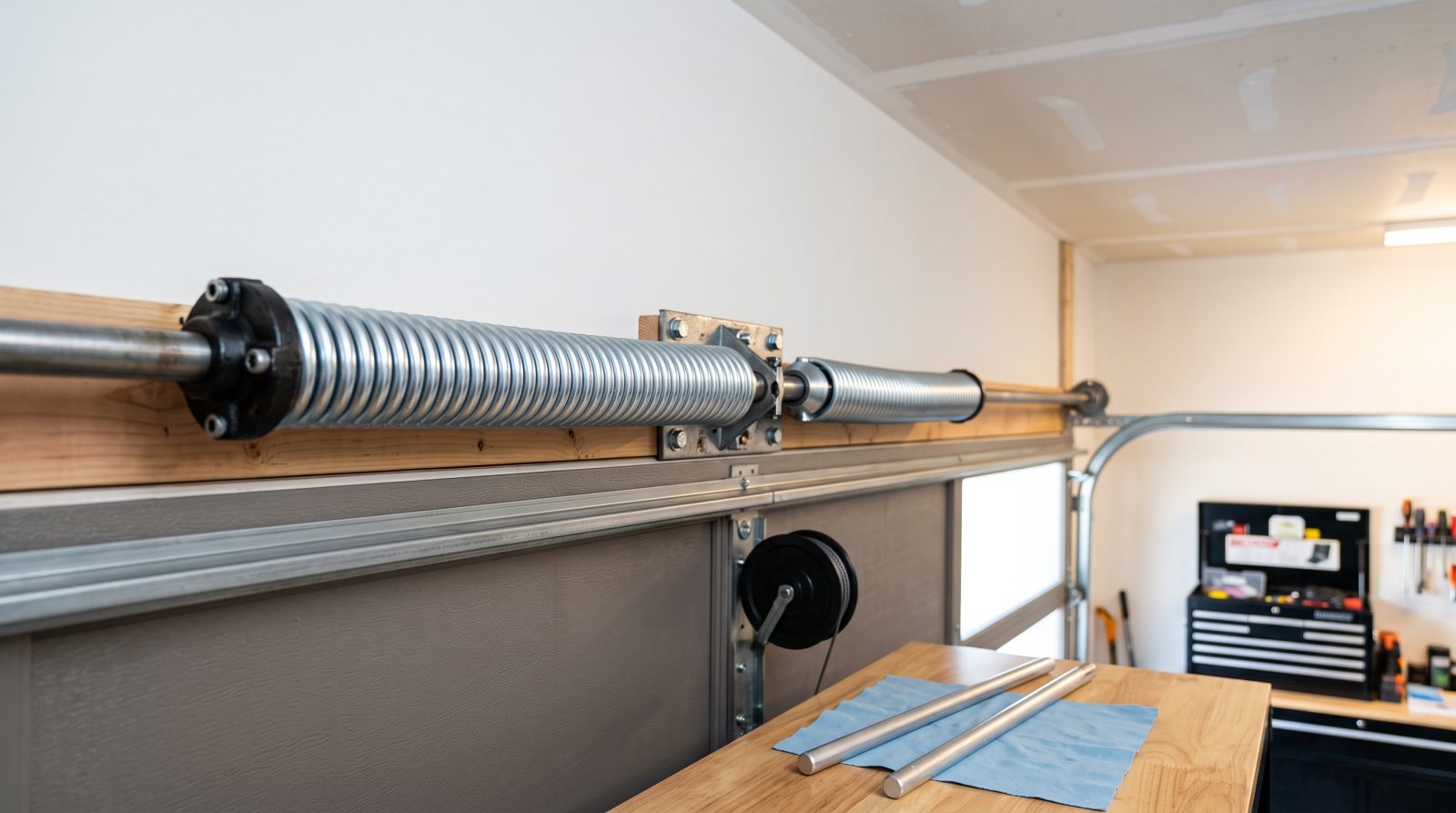
There are two main spring systems, and knowing which one you have explains a lot of the price difference. Torsion springs are the heavy coils mounted on a metal shaft above the door opening; they twist (torque) to do their work and are by far the most common on modern Bay Area doors. Extension springs are the long, stretched springs that run along the horizontal tracks on either side of the door, more common on older or lighter single-car doors. Torsion systems are generally more expensive to service because the springs are sturdier, the hardware is more involved, and the winding work demands more skill and the right tools.
Spring type also affects how the job should be scoped. On a two-spring torsion setup, springs are a matched pair installed at the same time and they age at the same rate — so when one breaks, the other is usually close behind. Replacing both at once costs a little more upfront but spares you a second service call (and second trip charge) within months. A reputable technician will explain this trade-off rather than quietly swapping only the broken one to keep the ticket looking cheap.
- Torsion springs: mounted on a shaft above the door; most common, sturdier, slightly pricier to service
- Extension springs: stretch along the side tracks; common on older/lighter doors, often a bit cheaper
- Two-spring doors: replacing both together saves a likely second visit soon after
- Heavier doors (solid wood, insulated steel, carriage-style) need stronger springs and cost more
What Actually Drives Your Spring Replacement Price
Beyond spring type, several real factors move the number. The first is door weight and size: an insulated double-wide steel door or a solid wood carriage door weighs far more than a basic single-car aluminum door, and heavier doors need heavier, more expensive springs sized to lift them safely. The second is spring quality and cycle rating. Springs are rated by 'cycles' — one up-and-down counts as one cycle. A standard spring might be rated around 10,000 cycles, while a high-cycle spring can be rated two to four times that. High-cycle springs cost more upfront but can dramatically extend the time between replacements, which matters a lot for busy households that run the door many times a day.
The third factor is the condition of the surrounding hardware. When a spring snaps, it often takes a toll on the cables, bearings, and center bracket, and a worn shaft or seized bearing left in place will chew through your new spring. A thorough technician inspects and, where needed, replaces these wear parts — which adds modest cost but protects the new spring. Finally, access and door style play a role: tight garages, high ceilings, low-headroom track systems, and specialty doors all take more time and sometimes specialized parts. None of these are upsells when they're genuinely needed; they're the difference between a repair that lasts years and one that fails again by next season.
- Door weight & size — heavier/wider doors need stronger, costlier springs
- Cycle rating — high-cycle springs cost more but last far longer
- Number of springs — one vs. a matched pair
- Worn cables, bearings, drums, or center bracket that should be replaced alongside the spring
- Door style and garage access — carriage doors, high-headroom, or tight spaces add labor
The '$49 Spring Special' Trap — How to Read a Quote
Bay Area homeowners searching for spring replacement will run into ultra-cheap headline prices — the kind of ad that promises a spring for less than a dinner out. The catch is almost always in what that number excludes. The headline price often covers a single, low-cycle spring only, with labor, the second spring, cables, bearings, and a service or trip charge all added once the technician is standing in your garage. By the time the door actually works again, the real total can land well above an honest, all-in quote you'd have gotten elsewhere — except now you've used a low-grade spring that may not last.
A trustworthy quote is clear about a few things before any work starts: how many springs are being replaced, the cycle rating of the springs, whether any related hardware (cables, bearings, rollers) is included, and whether there's a separate service or trip fee. Ask for the total installed price, not the per-part price. Because we're a mobile, we-come-to-you service across the Bay Area, a technician can assess the door on site and give you a straight number rather than a teaser rate that balloons. If a price sounds too good to be true for a part that holds a 200-pound door over your car, it almost certainly is.
- Ask: how many springs, and what cycle rating?
- Ask: are cables, bearings, and a service/trip fee included or extra?
- Get the total installed price in writing before work begins
- Be wary of headline prices that only cover one low-cycle spring
- Cheapest invoice ≠ cheapest outcome if the door is left poorly balanced
Repair, Replace, or Upgrade? Getting the Most Value
When a spring goes, you generally have three paths, and the right one depends on the age and condition of the whole system. If the door and opener are otherwise sound, a straightforward spring replacement is the most cost-effective fix and gets you back in business the same day. If the springs have already been replaced once or twice and other parts are worn, it can be worth upgrading to high-cycle springs and refreshing the cables, rollers, and bearings together — a modestly higher bill now that buys years of trouble-free operation and quieter, smoother travel.
Occasionally a snapped spring is the moment a homeowner discovers the door itself is near the end of its life — rusted sections, repeated failures, or an opener that's been straining against a poorly balanced door for years. In those cases it's reasonable to weigh repair against full replacement, and an honest technician will lay out both rather than pushing the bigger sale. The Bay Area's mild but damp, coastal-influenced climate is gentle on springs compared to harsh-winter regions, but salt air near the bay and frequent daily use in busy households both shorten spring life, so cycle rating is a smart place to invest. Whatever the path, a balanced door and a healthy spring protect your opener, your door panels, and the people who walk under it. For a clear, on-site assessment of your door, call for a free quote.
- Sound door + opener: simple same-day spring replacement is the best value
- Multiple past failures or worn parts: upgrade to high-cycle springs + refresh hardware
- Rusted, failing, or very old door: weigh repair vs. full replacement honestly
- A properly balanced door extends the life of your opener and panels