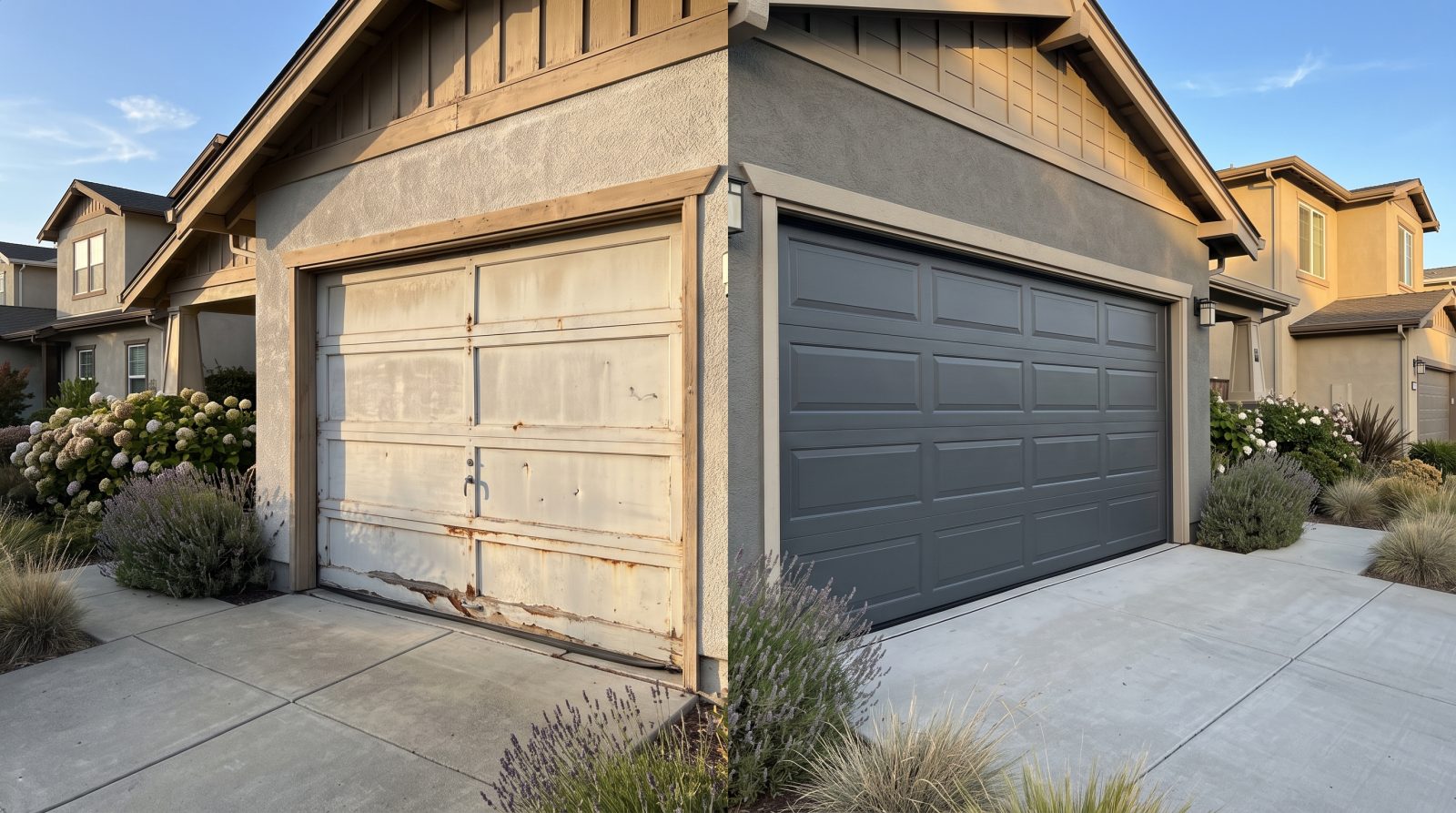
The short answer: lifespans by component
A garage door isn't a single appliance with a single expiration date. It's an assembly of parts that wear out independently, and understanding those separate clocks is the key to never being surprised by a failure. The panels, the opener, the springs, the rollers, and the cables each have their own typical service life, and the weakest of those determines when you'll be standing in your garage wondering why nothing is moving.
Below are realistic, industry-typical ranges. Treat them as estimates, not promises. Actual life depends heavily on how often the door cycles, the quality of the original parts, the local climate, and whether the system has been maintained. A door that gets a tune-up every year or two will routinely beat these numbers; a neglected one will fall short.
- Garage door (panels/section body): often 20-30+ years for a well-built steel or quality wood door, though it depends on material and exposure.
- Garage door opener (the motor unit): commonly 10-15 years, with the circuit board and drive components usually failing before the housing.
- Torsion or extension springs: frequently rated around 10,000 cycles, which for an average household lands roughly in the 7-12 year range, but a heavy-use home can burn through that in just a few years.
- Rollers: nylon rollers often last around 10-15 years; cheaper steel rollers tend to wear and get noisy much sooner.
- Cables: typically 8-15 years, sooner if they fray from rust or misalignment.
- Weather seal (bottom seal/threshold): usually 3-7 years before it hardens, cracks, or lets in water and rodents.
- Hinges and tracks: often outlast everything else if kept clean and aligned, but bent tracks and worn hinges do happen.
How long the door itself lasts (and what shortens it)
The door body is usually the longest-lived part of the whole system. A quality steel sectional door can serve 20 to 30 years or more, and many last longer if the finish is maintained and the panels aren't damaged by impacts. Material is the biggest factor in baseline lifespan. Insulated steel doors are durable and dimensionally stable; aluminum-and-glass doors resist rust but dent more easily; composite and modern faux-wood doors balance looks and low maintenance; and real wood doors are beautiful but the most demanding, because they expand, contract, and need refinishing to survive.
In the Bay Area, microclimate is the silent variable that determines whether a door hits the high end of its range or wears out early. Coastal communities like Pacifica, Half Moon Bay, San Francisco's Sunset and Richmond districts, Alameda, and parts of the Peninsula deal with persistent fog and salt-laden air that accelerate corrosion on steel components, fasteners, and springs. Inland areas like Walnut Creek, Concord, Livermore, and the East and South Bay valleys swing the other way: strong, direct sun and big daily temperature changes fade finishes, stress paint, and cause wood to move. Homes near the bay or in flood-prone low spots see more moisture at the bottom panel, where rust and rot usually start.
What actually shortens a door's life is rarely old age by itself. It's the accumulation of smaller problems: a dented bottom section that wicks water, a finish that was never resealed and now lets moisture into the substrate, a door run on failing springs so it slams down and stresses the panels, or hardware that rusted and seized. Catching these early is the difference between a door that needs a part and a door that needs replacing.
- Steel doors: long-lived, but watch for rust at the bottom edge and at fasteners, especially near the coast.
- Wood doors: gorgeous and repairable, but plan on periodic refinishing or they'll degrade faster than any other type.
- Aluminum/glass: rust-resistant and modern, but dents and seal failures around glass are the things to monitor.
- Any material near the coast: corrosion-resistant hardware and regular cleaning meaningfully extend life.
- Inland and sun-exposed doors: UV and heat are the enemies; a faded, chalky finish is your cue to refresh before damage goes deeper.
Openers: why the motor often dies before the door
The opener is the part most people assume will last forever and are surprised when it doesn't. A typical residential opener runs about 10 to 15 years. It's an electromechanical device with a circuit board, a motor, a drive system, and increasingly some wireless and smart-home electronics, and any of those can be the first to go. Often it's not a dramatic burnout but a slow decline: the unit gets louder, hesitates, reverses for no reason, or stops responding reliably to the remote.
Drive type influences both noise and longevity. Chain drives are the workhorses, durable and economical but louder. Belt drives run noticeably quieter and are popular under living spaces and bedrooms, which matters in Bay Area homes where the garage often sits beneath a room. Screw drives are simpler but can be sensitive to temperature swings. Newer DC motors with soft start/stop are gentler on the whole system and tend to age more gracefully than older AC units.
There's also a safety and security dimension to opener age that's worth weighing against pure mechanical life. Federally mandated photo-eye safety sensors became a requirement in the early 1990s, so any opener older than that should be replaced on safety grounds alone. Older units also use less secure remote codes, while modern openers use rolling-code encryption and add features like battery backup (genuinely useful during the Bay Area's planned power shutoffs and outages), Wi-Fi monitoring, and smartphone control. When an aging opener starts acting up, it's often the moment to upgrade rather than nurse it along, because a new unit buys you both reliability and meaningful safety improvements.
- Intermittent operation, random reversing, or ignored remote commands usually signal an opener nearing the end.
- Grinding or straining sounds can mean the opener, but they're just as often a spring or roller problem the opener is fighting against.
- Battery backup is a practical upgrade for power outages and shutoff events common across the region.
- Any opener predating photo-eye sensors should be replaced for safety, not just convenience.
Springs: the part most likely to fail first
If one component is going to strand you, it's almost always the springs. They store the energy that counterbalances the door's weight, doing the real lifting so the opener (or your arms) only has to nudge a balanced door. Because they're under enormous tension and flex on every single use, they wear out on a cycle count rather than calendar years. The industry shorthand is 'cycles,' where one cycle is one full open and one full close.
Standard springs are commonly rated around 10,000 cycles. Translate that into real life: a household that opens the door four times a day uses roughly 1,460 cycles a year, which puts a 10,000-cycle spring in the 7-year neighborhood. A busy family or a home-based business opening it eight or more times daily can chew through the same spring in three to five years. This is exactly why two identical doors installed the same week can need springs years apart. It's not quality, it's usage. Higher-cycle springs (15,000, 25,000, or more) cost more up front but can dramatically stretch the replacement interval for heavy users, and they're often the smarter buy for active Bay Area households.
Springs also fail faster in damp, salty coastal air, where surface rust increases friction and creates stress points that lead to breakage. A telltale sign of impending failure is a gap or a rusty, frayed look in the coils. When a torsion spring breaks, you'll often hear a loud bang like a firecracker, the door becomes extremely heavy and may not open, and the opener strains or refuses to lift it. Spring work is the single most dangerous part of garage door service because of the stored tension involved, and it's the one job we strongly recommend leaving to a professional rather than attempting as a DIY fix. Springs are almost always replaced in pairs even when only one has broken, because the surviving one is the same age and usage and is likely next.
- Spring life is measured in cycles, not years, so usage drives everything.
- Roughly 10,000 cycles is common; heavy daily use can mean replacement every few years.
- High-cycle springs cost more but can pay off for busy homes and small businesses.
- A loud bang, a door that suddenly feels very heavy, or visible gaps/rust in the coils point to a spring problem.
- Always treat spring replacement as professional work; the stored tension is genuinely dangerous.
Repair or replace? How to make the call
Once you understand that each part has its own clock, the repair-versus-replace decision gets much clearer. As a rule of thumb, single-component failures on an otherwise sound door are repairs: a broken spring, worn rollers, a failed opener, a frayed cable, or a dented panel can usually be addressed without touching the rest of the system. Replacement starts to make sense when multiple major parts are failing at once, when the door body itself is rotted, badly rusted, or structurally damaged, or when an old door is so far behind on safety and efficiency that piecemeal repairs are throwing good money after bad.
A simple gut check is the proportion of the cost. If a repair runs a small fraction of what a new door would, repair is almost always the move. When repairs start stacking toward a meaningful share of replacement cost, especially on a door that's already past its expected life, replacement usually wins because you reset every clock at once and gain modern insulation, quieter operation, better security, and improved curb appeal. For costs, expect everything here to vary by door size, material, spring type, opener features, and the specifics of your home; treat any figure you see online as a typical industry estimate rather than a quote, since real pricing depends on what's actually on your garage.
Bay Area considerations can tip the scale too. An insulated replacement door can make a real difference for garages converted to gyms, offices, or ADUs, which is increasingly common across the region. An opener with battery backup earns its keep during power shutoffs. And if your current door predates modern safety sensors or uses an old, easily copied remote, that alone can justify an upgrade. The best way to decide is a hands-on look at the actual balance, spring condition, and panel integrity, which is exactly the kind of evaluation our mobile service does at your home or business. If you're weighing it, we're glad to come out and give you an honest assessment so you can repair with confidence or replace without second-guessing. Call for a free estimate.
- Lean toward repair: one isolated failure (spring, roller, cable, opener, single dented panel) on an otherwise solid door.
- Lean toward replace: rotted/rusted/structurally damaged door body, several major parts failing together, or a door far past its service life.
- Run the math: small repair cost vs. replacement favors repair; stacked repairs on an old door favor replacement.
- Upgrades worth considering here: insulation for converted garages, battery backup for outages, modern safety sensors and rolling-code security.
How to make every part last longer
The good news is that lifespan is largely within your control. Most premature failures come down to neglect, and a modest amount of routine care pushes nearly every component toward the high end of its range. The single most valuable habit is paying attention. A garage door tells you when something is wrong well before it fails, through new noises, jerky movement, or a door that no longer glides smoothly.
A few minutes of maintenance a couple of times a year goes a long way, and it's even more important in coastal microclimates where salt air attacks metal. Keeping parts clean and properly lubricated reduces the friction that accelerates wear, and testing the door's balance and safety features catches problems while they're still cheap fixes. For anything involving spring tension, leave it to a professional, but the lighter maintenance below is well within a homeowner's reach and genuinely extends the life of the whole system.
- Lubricate the moving metal parts (rollers, hinges, springs, bearings) a couple of times a year with a proper garage door lubricant, not WD-40, which can attract grime.
- Test the balance: with the opener disengaged, lift the door halfway by hand. A balanced door stays put; one that slams down or flies up signals spring trouble.
- Check the photo-eye sensors and the auto-reverse safety feature regularly so the door reverses when something is in its path.
- Keep tracks clear of debris and wipe down hardware, especially near the coast, to slow corrosion.
- Inspect cables and springs visually for fraying, rust, or gaps, and call a pro at the first sign rather than waiting for a break.
- Replace a hardened or cracked bottom seal promptly to keep out water, drafts, and rodents.
- Schedule a professional tune-up periodically, particularly for high-use doors, to catch wear before it becomes a failure.