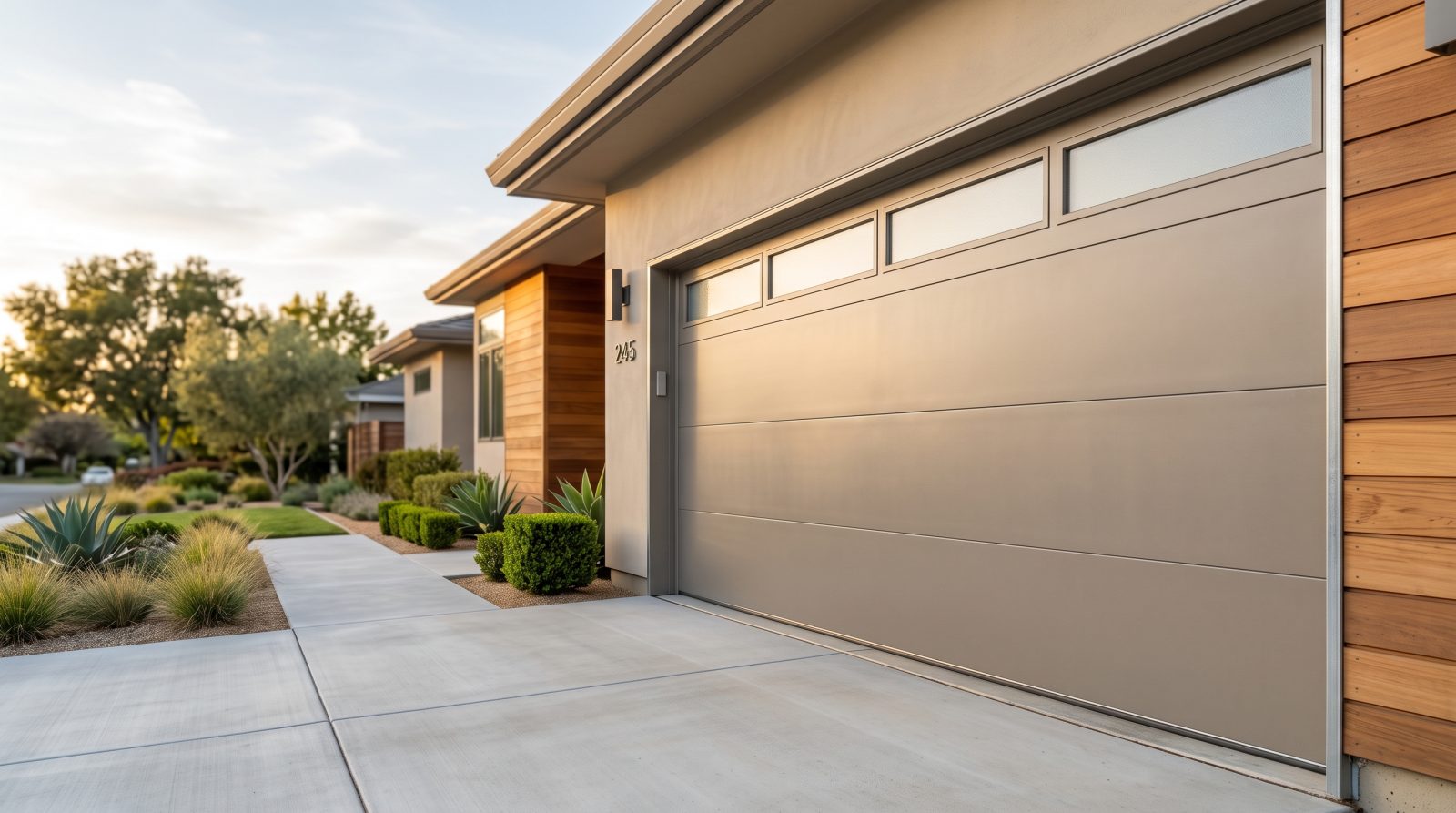
Typical Installed Cost Ranges for a New Garage Door
When people ask what a garage door costs, they almost always mean the installed price: the door, the tracks, the springs, the hardware, the haul-away of the old door, and the labor to put it all in correctly. As a broad Bay Area estimate, a basic single-car steel door installed commonly lands in the rough range of $1,000 to $2,200, a standard double-car steel door in the $1,800 to $4,000 range, and premium doors (insulated, custom-color, full-view glass and aluminum, or real wood and faux-wood) climbing well past $4,000 and into five figures for high-end custom work.
Those bands are wide on purpose, because the spread between the cheapest and most expensive door that fits the same opening is enormous. A no-frills single-layer steel pan door and a triple-layer insulated carriage-house door with decorative glass both 'fit' a standard 16-foot opening, but they are not the same purchase. Where you land inside the range depends on the choices covered in the sections below: material, size, insulation, and the condition of everything the new door bolts onto.
Treat any single number you see advertised with healthy skepticism. A door price that looks too good usually excludes the spring system, the tracks, the opener, or the labor, and those line items are exactly where a clean installation succeeds or fails. A fair quote should spell out what's included so you can compare apples to apples.
- Single-car steel door, installed: roughly $1,000 to $2,200 (typical estimate)
- Double-car steel door, installed: roughly $1,800 to $4,000 (typical estimate)
- Premium insulated, glass, or wood doors: $4,000 and up, custom builds higher
- These are installed ranges including door, hardware, springs, and basic haul-away — confirm inclusions in writing
What Actually Drives the Price Up or Down
Material is the single biggest lever. Steel is the workhorse of Bay Area garages because it's affordable, low-maintenance, and holds up well; within steel, the difference is gauge (thickness) and the number of layers. Aluminum-and-glass full-view doors carry a modern look and a higher price. Real wood is beautiful and expensive, and it asks for ongoing maintenance, which matters more in our damp coastal microclimates. Faux-wood composite splits the difference, giving you the carriage-house look without the upkeep.
Size and configuration come next. A double-wide door uses more material and is heavier, which means a beefier spring system and more careful balancing, so it costs more than two single doors' worth of square footage might suggest. Non-standard openings, taller doors for lifted trucks or shop bays, and arched or custom headers all add cost. Many older Bay Area homes — think mid-century ranch houses in the South Bay, or narrow garages tucked under San Francisco flats — have openings that aren't perfectly standard, and that affects both the door and the labor.
Finally, the hidden drivers: the spring system, the opener, and the existing structure. Switching from an old extension-spring setup to a properly sized torsion system, adding insulation, replacing rusted or bent tracks, or installing a new opener with safety sensors all move the total. Decorative glass, windows, custom paint or factory color matching, and upgraded weather seals each add their own increments.
- Material: steel (most affordable) → composite/faux-wood → aluminum-glass → real wood (most premium)
- Size: single vs. double vs. oversized shop or RV-height openings
- Insulation: single-layer (none) vs. double- and triple-layer insulated
- Spring system: extension vs. correctly sized torsion springs
- Opener: reuse existing vs. new opener with modern safety sensors
- Extras: windows, decorative glass, custom color, upgraded weather sealing
Insulation: Why It Matters More Than You'd Think in the Bay Area
Garage door insulation is rated by R-value, and it's one of the upgrades that quietly earns its keep here. The Bay Area's reputation for mild weather hides a lot of microclimate variety: foggy, cool coastal mornings near the ocean and in the avenues; genuinely hot inland afternoons in the East Bay valleys, the South Bay, and out toward the Tri-Valley. If your garage is attached to the living space, doubles as a gym, workshop, laundry room, or home office, or sits under a bedroom, an insulated door makes that space noticeably more comfortable and easier to heat or cool.
Insulated doors are built in layers. A single-layer (non-insulated) steel door is the lightest and cheapest. A double-layer door adds insulation backed by a vinyl or steel skin; a triple-layer door sandwiches thicker insulation between two steel skins, giving the highest R-value, the most rigidity, and a real reduction in outside noise — a genuine benefit if your garage faces a busy street or you run equipment early or late.
Beyond comfort, insulated doors tend to be quieter in operation and more dent-resistant thanks to that sandwiched construction. The trade-off is upfront cost: stepping from single-layer to insulated typically adds a few hundred dollars or more depending on the door. For attached garages and any garage you actually spend time in, most homeowners find it worth it.
- Single-layer: lightest, lowest cost, no thermal benefit — fine for a detached, purely-for-cars garage
- Double-layer: insulation plus a backing skin — a solid middle ground
- Triple-layer: highest R-value, quietest, most rigid and dent-resistant — best for attached or living-space garages
- Insulation upgrade typically adds a few hundred dollars or more vs. a comparable single-layer door
Costs Beyond the Door: Springs, Openers, and Haul-Away
A replacement project is rarely just the door panel. The torsion or extension springs do the actual lifting, and they're sized to the specific weight of your new door — a heavier insulated or wood door needs a different spring than a light single-layer steel one. If your installer reuses undersized old springs on a heavier new door, the door will wear out the system prematurely and may not balance correctly. Proper springs are part of a correct replacement, not an upsell.
The opener is its own decision. If your existing opener is in good shape and matches the new door's weight, it can often be reused, which keeps cost down. But many replacements are a natural moment to upgrade — a newer opener brings quieter belt-drive operation, battery backup so you're not stuck during a power outage, smartphone control, and modern photo-eye safety sensors. A new opener is commonly a few hundred dollars installed, depending on the model and features.
Don't forget the small line items that round out a real quote: haul-away and disposal of the old door, new weather seal along the bottom and sides, and new tracks if the old ones are bent or corroded — corrosion is a real factor for garages near the coast and the Bay's salt air. A trustworthy estimate names these things instead of surprising you with them on installation day.
- Springs: must be sized to the new door's weight — not a place to cut corners
- Opener: reuse if compatible, or upgrade for quiet drive, battery backup, and app control (commonly a few hundred dollars installed)
- Haul-away: removal and disposal of the old door and hardware
- New weather seal and, if needed, new tracks — especially where coastal salt air has caused corrosion
Repair vs. Replace: When a New Door Is the Smarter Spend
Not every problem calls for a full replacement, and a good company will tell you so. If your door is structurally sound and the issue is a broken spring, a frayed cable, a worn opener, or a single dented section, a targeted repair is usually the better value. Springs and cables are wear items; replacing them on an otherwise healthy door is far cheaper than a new door and restores normal operation.
Replacement starts to make more sense when repairs stack up or the door is simply at the end of its life. Tell-tale signs include multiple panels dented or rusting through, sagging or cracked wood, a door that's grown dangerously heavy or unbalanced, repeated breakdowns within a short span, or a single-layer door on a garage you've since converted into living or working space. Curb appeal and home value are legitimate reasons too — a new door is one of the highest-return exterior upgrades on a Bay Area home, where buyers notice the front elevation.
Safety is the line that overrides budget. If the door has come off its tracks, a cable has snapped, or the springs are visibly damaged, stop using it and don't try to force it open or closed — those components are under extreme tension and are genuinely dangerous to handle. That's the moment to have a pro assess it in person, on-site, and tell you honestly whether a repair or a replacement is the right call.
- Repair when: a single broken spring, frayed cable, worn opener, or one dented section on an otherwise sound door
- Replace when: multiple failing panels, rust or wood rot, chronic breakdowns, or a single-layer door on a now-living space
- Replace for value: a new door is one of the highest-ROI exterior upgrades for resale
- Safety first: a door off its tracks or with a snapped spring should be left alone until a pro inspects it