What Photo-Eye Safety Sensors Actually Do
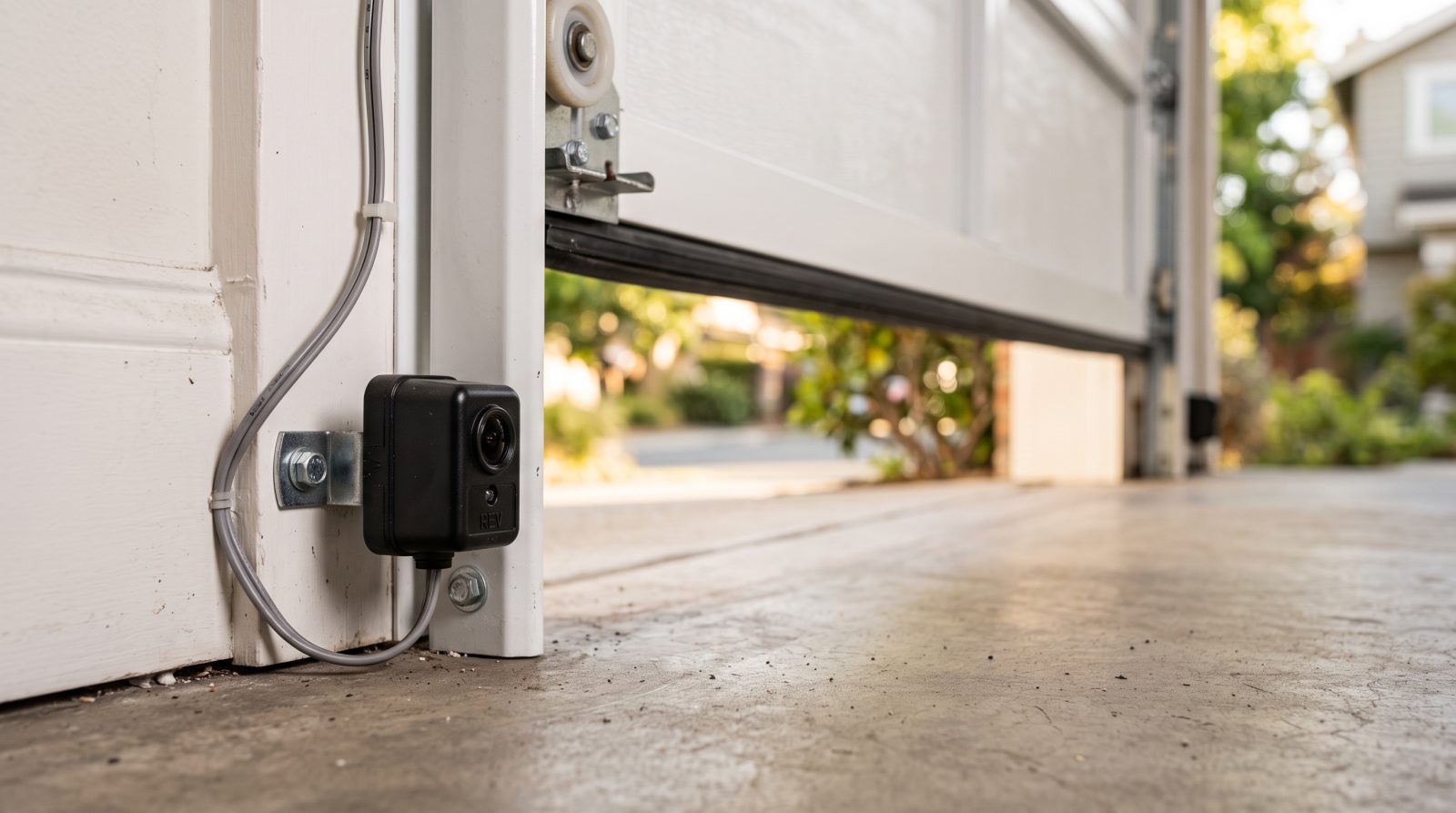
Every residential garage door opener manufactured for the U.S. market since 1993 is required by federal law to include an external entrapment-protection system. In practice, that system is a pair of photo-electric sensors, usually called photo-eyes, mounted on each side of the door opening roughly four to six inches off the ground. One sensor sends a focused infrared beam straight across the doorway; the sensor on the opposite side receives it. As long as that invisible beam is unbroken, the opener knows the path is clear and will allow the door to close.
The moment something interrupts the beam while the door is closing, a pet walking through, a trash can, a child's foot, a bicycle tire, the opener instantly reverses the door back to the fully open position. This is not a malfunction; it is the safety system doing exactly its job. The same logic is why a misaligned, dirty, or unplugged sensor produces the classic symptom of a door that will not close: from the opener's point of view, the beam is broken, so it assumes a person or object is in the way and refuses to risk crushing it.
It is worth being clear about why this matters beyond convenience. A garage door is the largest and heaviest moving object in most homes, often 150 pounds or more. Before photo-eyes were mandated, closing doors were a genuine cause of serious injuries to small children and pets. The two cheap-looking sensors by your floor are, quite literally, a life-safety device. That is the reason we never recommend bypassing or disabling them, even temporarily.
The Telltale Signs Your Sensors Are the Problem
Sensor faults have a very recognizable signature, and once you know the pattern you can usually diagnose the issue before anyone touches the door. The most useful clue is the difference between how the door behaves on open versus close. Safety sensors only govern the closing cycle, so a door that opens normally every time but refuses to close, or reverses partway down, points almost directly at the photo-eyes.
Most openers also tell you what they are thinking through their LED lights. On the great majority of belt- and chain-drive units, a steadily lit sensor light means the beam is aligned and healthy, while a blinking or flashing light, often 1, 5, or 10 blinks depending on the brand, signals a blocked, dirty, or misaligned beam. If you press the wall button and the door tries to close but immediately rolls back while the opener light flashes, that is the system reporting a broken beam.
Common symptoms that point to the sensors rather than the springs, motor, or remote include:
- The door opens fine but will not close, or closes a few inches and reverses
- One sensor LED is off or blinking instead of glowing steadily
- The door only closes if you hold the wall button down the entire way (a deliberate manufacturer override that bypasses the eyes — a clear sign the beam is broken)
- The opener motor light flashes repeatedly after a failed close attempt
- The problem appeared right after a car bump, a stored item shifted, or yard work near the door tracks
Why Sensors Fall Out of Alignment in the First Place
Photo-eyes are precise little instruments aimed across an opening that can be eight to sixteen feet wide, so they do not need to move much to lose contact. A nudge of a few degrees on either bracket is enough to send the infrared beam past its target instead of into it. Understanding the usual culprits helps you both fix the current issue and prevent the next one.
The most frequent cause is simple physical contact. A car door swinging open, a kid's bike leaning against the bracket, a leaf blower, or a broom handle can all knock a sensor a fraction of an inch out of true. Lawn equipment and pressure washers are repeat offenders. Vibration over time also plays a role: every cycle of a heavy door shakes the frame slightly, and over months a loose mounting screw lets a sensor droop.
Bay Area conditions add their own twists. Homes closer to the coast and the bay, from the avenues in San Francisco out to Pacifica, Alameda, and the Marin shoreline, deal with persistent marine fog and salt-laden air that corrode bracket screws and fog or film the sensor lenses. Inland and South Bay garages in places like San Jose, Fremont, and the Tri-Valley see long dry spells where fine dust and pollen accumulate on the lens until the beam simply cannot punch through. And in older housing stock, the Victorians and mid-century homes common across Oakland, Berkeley, and the Peninsula, wood-framed garages settle and shift seasonally, slowly pulling brackets out of alignment. None of this is exotic; it is just the everyday wear a coastal-and-valley climate puts on a sensitive optical device.
How to Realign and Clean Your Sensors (Step by Step)
A surprising share of sensor problems are something a homeowner can resolve safely in under fifteen minutes, because realigning and cleaning the photo-eyes involves no springs, no high-tension components, and no electrical work beyond a gentle wiggle of a low-voltage wire. Here is the sequence we follow, and the one we are happy to walk you through.
Start by looking, not touching. Stand inside the garage and check both sensor LEDs. Identify which one is dark or blinking; that is usually the receiver that has lost the beam. Then work through the checklist below in order, testing the door after each step rather than changing five things at once. Most fixes happen in the first three steps.
- Clean both lenses gently with a dry, soft microfiber cloth — fog film, dust, cobwebs, and even a smear can break the beam. Avoid harsh solvents that can cloud the plastic.
- Clear the path: make sure nothing (a bin, a bag, a low-hanging cord) is interrupting the beam, and that no bright sunlight is shining directly into a lens, which can occasionally wash it out at certain times of day.
- Check the wires: confirm both sensors are firmly seated and the thin low-voltage wires at the back are not pinched, chewed, or pulled loose. A staple through a wire is a classic hidden cause.
- Realign by hand: loosen the wing nut or screw on the bracket just enough to pivot the sensor, then aim both eyes at the same height pointing directly at each other. Watch the LED — when it stops blinking and glows steady, you have found alignment. Gently retighten without nudging it.
- Confirm equal height: if the brackets have drifted, use a tape measure so both sensors sit at exactly the same distance off the floor; mismatched heights are a frequent reason a steady beam cannot be found.
- Test the close cycle two or three times to make sure it holds, ideally after letting the door sit a few minutes so a marginal alignment reveals itself.
When It Is Not the Alignment — and When to Call a Pro
If you have cleaned the lenses, cleared the path, checked the wiring, and carefully realigned both eyes but the LED still will not hold steady, the problem has likely moved past simple adjustment. At that point you are usually looking at a failed sensor, a damaged or shorted wire run inside the wall or along the track, corroded connections from years of coastal moisture, or an aging opener logic board that is misreading a perfectly good beam. These are diagnosable and fixable, but they call for testing tools and replacement parts rather than a screwdriver and a cloth.
There is also an important safety boundary to respect. The hold-to-close override built into most openers exists for narrow situations, but it should never become your everyday workaround, because running it routinely defeats the entrapment protection the sensors provide. If the only way you can close your door is by holding the button, treat that as a repair that needs attention, not a setting you can live with. Likewise, never tape, foil, or face the two sensors at each other on a workbench to trick the opener into ignoring the doorway; that disables the safety system entirely.
This is exactly the kind of call where a mobile service earns its keep. Because we come to you anywhere across the Bay Area, a technician can test the sensors and the opener's logic board on site, confirm whether it is a sensor, a wire, or the board, and in many cases replace a faulty photo-eye pair the same visit. Sensor and wiring repairs typically fall at the lower end of garage door service costs, while a replacement opener logic board sits higher; either way, expect a range that varies with your opener brand, the parts involved, and the scope of the work rather than a fixed figure. If your door will not close and you have run through the steps above without luck, reach out and we will get it diagnosed and back to safely closing on its own. Call for a free estimate and we will come to you.