What Counts as a Same-Day Garage Door Emergency
Not every garage door problem is urgent, and knowing the difference saves you money. A door that is slightly noisy or a little slow can often wait for a planned tune-up. But certain failures compromise security, safety, or your ability to get in and out of your home, and those are the ones that justify a same-day mobile visit. The fastest way to know which category you are in is to ask: is the door currently stuck open, stuck closed, hanging unevenly, or making a loud bang followed by total failure? Any of those is an emergency.
The single most common urgent call is a broken torsion or extension spring. Springs are wound under enormous tension and counterbalance the entire weight of the door, which on Bay Area homes commonly runs from roughly 130 to over 350 pounds depending on whether it is a single steel panel door or a heavy insulated double. When a spring snaps, you will often hear a sound like a firecracker, and the door becomes far too heavy for the opener to lift. This is both an access problem and a safety problem, because attempting to force the door can damage the opener or cause the door to drop.
Other failures that warrant same-day attention include a door that has come off its tracks (the panels look crooked or jammed against the frame), a snapped or frayed lift cable, a door that slammed down hard, and an opener that has completely died leaving the door locked in place. Security-related situations also qualify: a door that will not close and seal at night, or a door damaged after a vehicle backed into it, leaving your garage and the interior door to your home unsecured.
- Broken spring: loud bang, door suddenly far too heavy, opener strains or won't lift
- Off-track door: panels crooked, jammed, or visibly leaning to one side
- Snapped lift cable: door hangs unevenly or drops on one side
- Door stuck open: security risk, especially overnight or while you're away
- Door stuck closed: vehicle or equipment trapped inside
- Door won't seal or close fully: home is exposed to weather and intrusion
- Impact damage: a car backed into the door and it no longer operates safely
What We Can Typically Fix on the First Visit
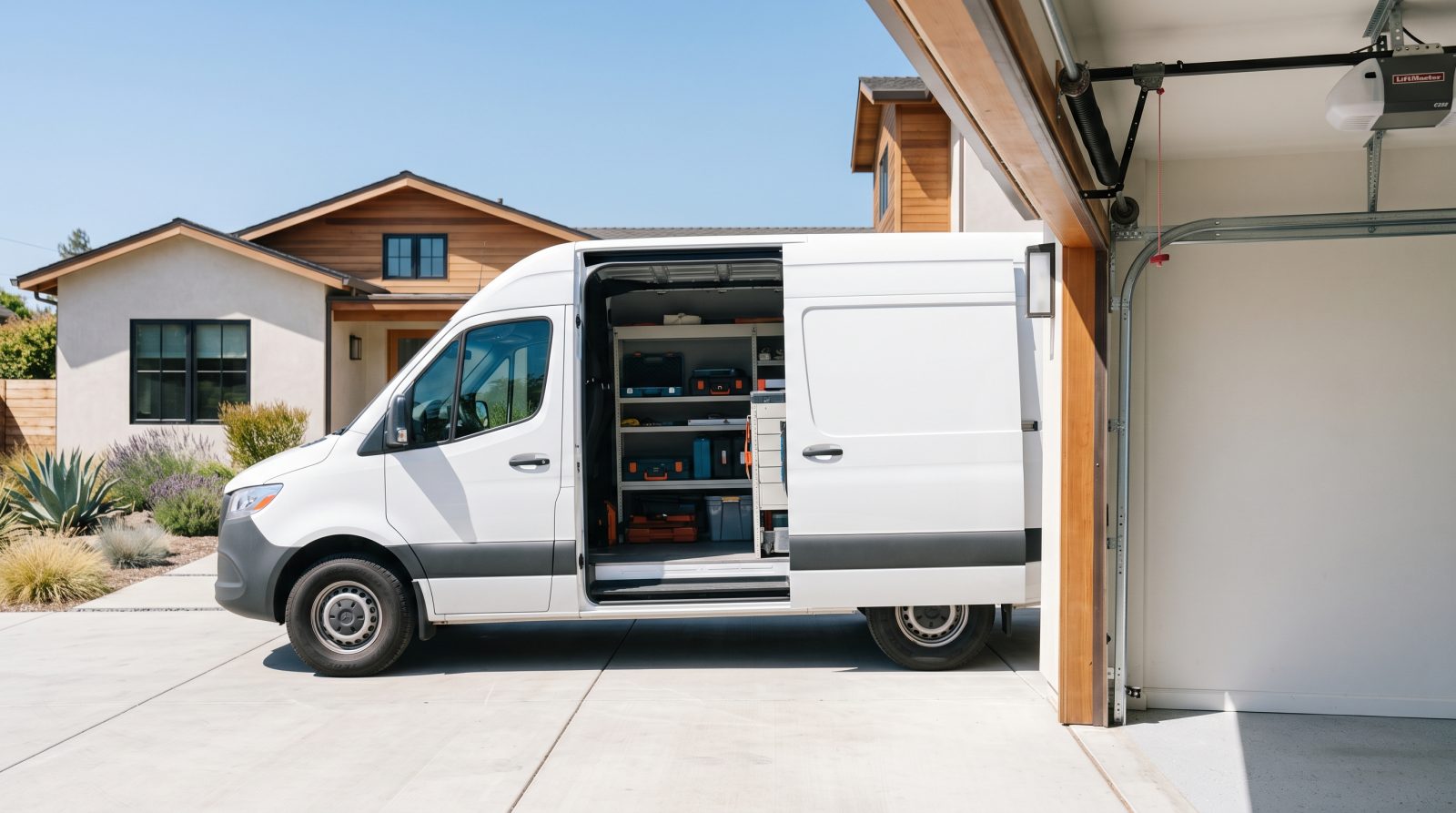
Because we operate as a mobile service, our vehicles are stocked to handle the most common urgent repairs on the spot, which is the whole point of a same-day call. The goal of an emergency visit is to restore safe operation in one trip whenever the parts and conditions allow, rather than diagnosing today and returning later. The majority of urgent residential and light-commercial garage door failures fall into a handful of repeatable categories, and those are exactly the ones we focus on resolving immediately.
Spring replacement is the headline repair. When a spring breaks, the correct fix is to replace it with a properly sized spring matched to the door's weight and travel, and on a two-spring system it is standard practice to replace both at once because they wear at the same rate; replacing only one usually means a second failure soon after. Cable replacement, roller replacement, and re-setting a door back onto its tracks are similarly routine. Bent or worn rollers and dry, binding tracks are a frequent cause of off-track events, especially on older Bay Area homes where the door hardware may be decades old.
Opener problems range from simple to involved. Sometimes the unit only needs a sensor realignment, a logic-board reset, a new gear assembly, or a worn drive component, all of which are commonly handled same-day. In other cases an older opener has genuinely reached end of life and replacement is the sensible recommendation. Either way, the first visit is about getting you a working, safe door and a clear explanation of what failed and why, so you can make an informed decision rather than a pressured one.
- Torsion and extension spring replacement, sized to your specific door
- Lift cable replacement and re-tensioning
- Off-track door realignment and roller replacement
- Opener diagnostics: sensor alignment, gears, drive components, board resets
- Hinge, bracket, and bottom-seal repairs that affect operation or security
- Straightforward assessment when a repair would only postpone an end-of-life failure
What To Do While You Wait for the Technician
The minutes between a failure and the technician's arrival are when most accidental damage and most injuries happen, almost always because someone tries to force the door or fix the spring themselves. The most important guidance is simple: stop operating the door. If a spring is broken or a cable has snapped, repeatedly hitting the opener button strains the motor and can burn out the drive, turning a single repair into two. If the door is partway open and crooked, do not pull on it or stand underneath it.
Garage door springs and cables hold enough stored energy to cause serious injury, which is why spring work is genuinely a professional job and not a DIY project, regardless of what a video suggests. Resist the temptation to wind a torsion spring, swap a cable, or pry a door back onto its track yourself. A door that drops because a counterbalance was released incorrectly can cause real harm and significant property damage.
There are, however, a few safe and useful things you can do. If you can do so safely and the door is fully closed, leave it closed and use another entrance. If the door is stuck open and you are concerned about security, stay nearby until help arrives rather than attempting a manual fix. Take a quick photo of the failure on your phone; sharing what you see helps us arrive with the right parts and gives us a head start on the diagnosis.
- Stop pressing the opener button; repeated attempts can burn out the motor
- Do not attempt to wind springs, replace cables, or re-track the door yourself
- Keep people, pets, and vehicles clear of and out from under the door
- If the door is open and security is a concern, stay nearby until help arrives
- Snap a photo of the broken part so we can bring the right components
- Note any sounds you heard (a bang, grinding, or clicking) to aid diagnosis
Mobile, We-Come-to-You Service Across the Bay Area
Bay Area Garage Door is a fully mobile operation, which means there is no shop to drive to and no waiting in a queue at a counter. We bring the repair to your driveway, whether you are in a San Francisco Edwardian with a single tucked-under garage, a Peninsula ranch home, an East Bay split-level, a South Bay tract home, or a North Bay property with a detached garage. The Bay Area's mix of housing eras matters for repair, because hardware on a mid-century home behaves very differently from hardware on newer construction, and a mobile technician who has seen both can adapt on site.
Local conditions shape what fails and how often. Coastal and bayside areas like the Sunset, Daly City, Pacifica, and parts of the East Bay shoreline deal with persistent marine fog and salt-laden air, which accelerates rust on springs, cables, and rollers and is a leading cause of premature corrosion failures. Inland valleys in the South Bay and eastern reaches see hotter, drier swings that dry out lubrication and harden weather seals. Knowing these patterns helps us not only fix the immediate problem but also point out the next likely weak point before it strands you.
Because the region's commute realities mean a non-working garage door can derail an entire day, we prioritize fast, same-day response for urgent failures whenever scheduling allows. We serve homeowners and businesses alike, so whether it is a single residential door or a roll-up at a small commercial unit, the same mobile, we-come-to-you approach applies.
- No storefront trip required; the repair comes to your driveway
- Experience across SF, Peninsula, East Bay, South Bay, and North Bay homes
- Familiar with coastal-corrosion and inland-dry-climate failure patterns
- Service for both residential doors and light-commercial roll-up doors
Understanding Same-Day Repair Costs
Cost is the question on everyone's mind during an emergency, and the realistic answer is that it depends on what actually broke. A firm price given over the phone before anyone has seen the door is only a guess. What we can offer is realistic industry-range guidance so you are not blindsided, with the understanding that these are estimates that vary by region, door size and weight, material, hardware age, and the scope of the work, and that an on-site look gives you an accurate number.
As general industry ranges in a higher-cost market like the Bay Area, spring replacement commonly falls in the range of roughly a few hundred dollars, with two-spring systems costing more than single-spring jobs because both springs and the labor to wind them are involved. Cable and roller replacements are typically more modest, often in the low hundreds, while opener repairs vary widely depending on whether a small part or a full unit is needed. A heavier insulated double door costs more to service than a light single door simply because the components are larger and carry more load.
A few principles keep costs fair and predictable. First, repairing related worn parts together (both springs, a full set of rollers) often prevents a second service call and a second trip charge. Second, the cheapest-sounding fix is not always the real fix; replacing one tired spring on a two-spring door usually means paying again shortly. Third, you should always get a clear explanation of the diagnosis before any work begins. When you are ready, call for a free quote and we will give you a straight, itemized estimate based on what your door actually needs.
- A look at the door in person gives an accurate, itemized estimate
- Spring jobs are usually the largest urgent repair; two-spring systems cost more
- Cable and roller work is typically more modest, often in the low hundreds
- Heavier insulated and double doors cost more to service than light single doors
- Fixing related worn parts together can avoid a second trip and second charge