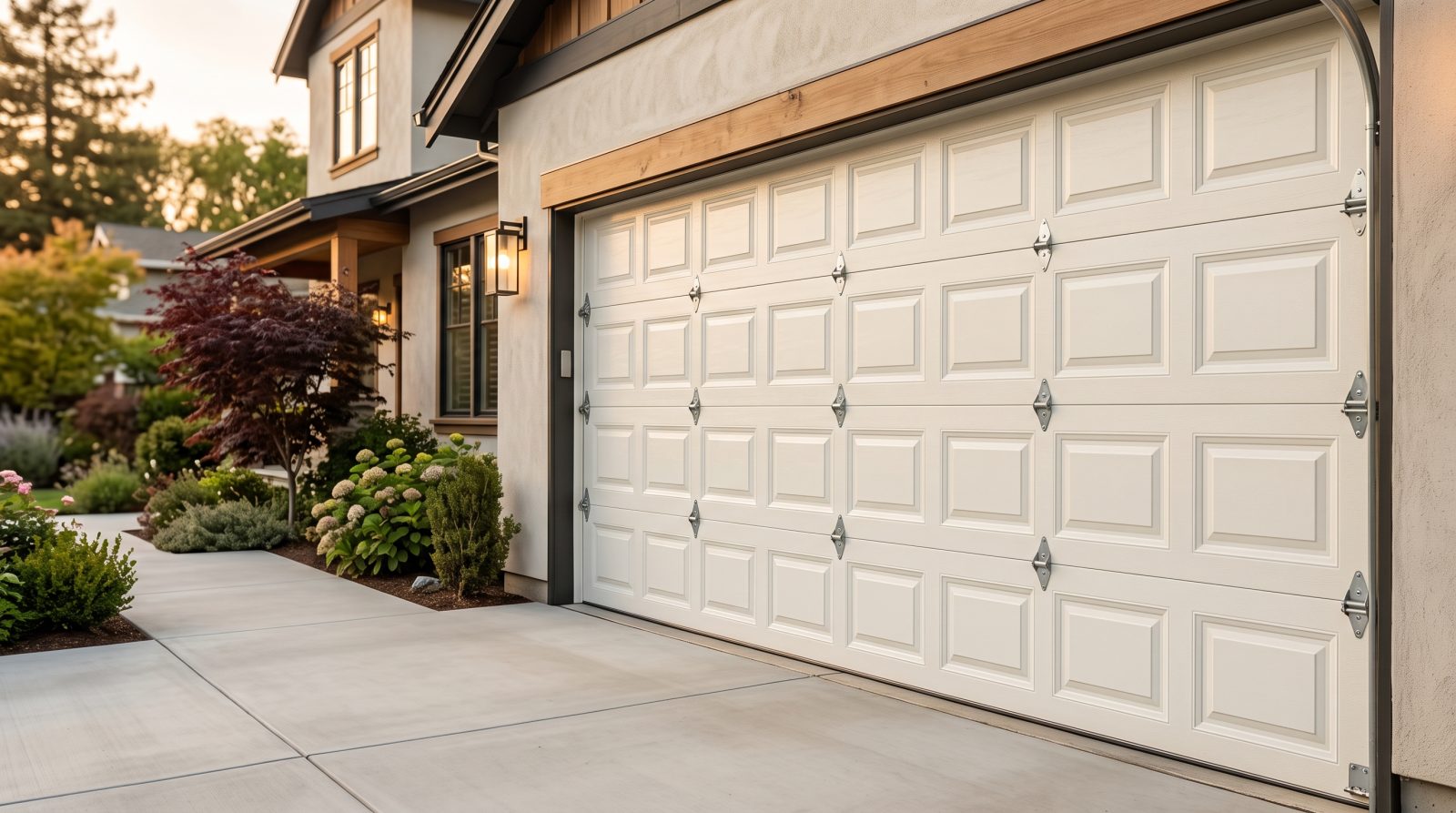
How a sectional garage door actually works
A sectional door is not one slab. It is a stack of horizontal sections, usually three to five panels tall, connected by hinges along each horizontal seam. Those hinges are what let the door bend from vertical (closed) to horizontal (open). At the end of every panel sits a roller, and each roller rides inside a steel track mounted to the wall and ceiling. The track has a vertical run beside the opening and a curved section near the top that flattens out under the ceiling. As the door opens, the panels follow that curve one at a time and end up parked flat overhead, which is why a sectional door needs almost no clearance in front of it and works on short Bay Area driveways where a swing-out or one-piece tilt door never could.
The part that does the real lifting is not the opener motor, and this surprises a lot of homeowners. The counterbalance spring system carries the weight of the door. Most sectional doors use a torsion spring mounted on a steel shaft above the opening, or a pair of extension springs running parallel to the horizontal tracks. When the door is down, the spring is wound tight and stores energy; as the door rises, that stored energy is released to offset the door's weight. A properly balanced door feels nearly weightless by hand. The opener's only job is to give it a nudge and hold it in position, which is why a healthy door can be lifted with one or two fingers when it is disconnected from the opener.
Tying it all together are the lift cables, drums, and bottom-corner brackets. Steel cables run from the bottom of the door up to drums on the spring shaft, translating the spring's rotation into vertical lift. This is also the most dangerous zone of the door: the cables and the bottom brackets are under the full load of the spring even when the door is closed, which is why DIY spring and cable work sends people to the emergency room every year. The rest of the system, panels and hinges and rollers, is comparatively forgiving. The spring side is not.
- Panels: 3 to 5 horizontal sections hinged together so the door can bend around the track curve
- Tracks and rollers: steel tracks guide rollers from vertical to horizontal, parking the door flat overhead
- Counterbalance: torsion or extension springs carry the door's weight, not the opener motor
- Cables and drums: translate spring force into lift; under full tension even when the door is closed
- Opener: provides the nudge and holds position, but is not the muscle of the system
Why sectional doors became the Bay Area standard
Drive through Sunset District flats, Oakland bungalows, Peninsula ranch homes, or newer South Bay and Tri-Valley subdivisions and you will see sectional doors almost everywhere. The first reason is geometry. Bay Area lots are often tight, driveways are short, and a one-piece tilt-up door swings outward into the very space you need to pull into. A sectional door moves straight up and parks overhead, so you can stop your car close to a closing door without it clipping the bumper. For garages converted into living space or with shelving and storage above, the flat overhead park is a real advantage.
The second reason is sealing and comfort. Because each panel meets the next with a tongue-and-groove or shiplap joint, and the bottom panel carries a flexible weatherseal against the floor, a sectional door closes up tight. That matters more here than people expect. A west-facing garage in Pacifica or Daly City takes constant marine fog and wind-driven moisture; a garage in Walnut Creek or San Jose bakes in summer afternoon heat. A well-sealed, optionally insulated sectional door keeps the garage and any rooms above or beside it noticeably more stable in temperature, and keeps salt air and grit from blowing in.
The third reason is looks and value. Sectional construction is what makes the modern carriage-house, flush, and full-view glass-and-aluminum styles possible, because the panel design can be changed without changing the basic mechanics. In a region where curb appeal moves home prices hard, the garage door is often the largest single design element on the front of the house, and the sectional format gives you the widest menu of finishes to work with.
Materials and insulation: choosing the right sectional door
Sectional doors come in a handful of core materials, and the right pick depends on where in the Bay Area you live and what the garage is used for. Steel is the most common: durable, low-maintenance, and available in everything from a basic single layer to a three-layer steel-insulation-steel sandwich. Steel handles our climate well, though near the immediate coast you want a good factory finish and should rinse salt residue off periodically. Aluminum with glass panels is the choice for the modern full-view look you see on contemporary homes in places like the Berkeley Hills or newer San Jose builds; it is light and rust-resistant but the large glass area offers little insulation on its own.
Wood and wood-composite doors deliver the warmth of true carriage-house and craftsman styling that suits a lot of older East Bay and Peninsula homes. Real wood is beautiful but asks for periodic refinishing, especially on sun-blasted or fog-exposed elevations; composite and faux-wood steel give you a similar look with far less upkeep. Fiberglass and vinyl are less common but worth knowing about: both resist dents and corrosion, which can appeal right on the coast, though fiberglass can fade or grow brittle under years of direct sun.
Insulation is the upgrade most homeowners underrate. Insulation is rated by R-value, and a door's rating depends on whether it is single-layer (no insulation), double-layer (a backing of polystyrene), or triple-layer (polyurethane foam bonded between two steel skins). If your garage is attached, sits under a bedroom, or doubles as a gym, workshop, or office, an insulated door pays you back in comfort and quieter operation. Polyurethane-core doors are also structurally stiffer, which means they hold their shape better over a wide opening and tend to run more smoothly for longer. For a detached storage-only garage, a basic non-insulated door may be all you need.
- Steel: most popular, durable, low-maintenance; rinse salt off near the coast
- Aluminum and glass: modern full-view look, light and rust-resistant, low insulation
- Wood and composite: warm carriage-house styling; real wood needs periodic refinishing
- Fiberglass and vinyl: dent- and corrosion-resistant, good coastal options
- Insulation (R-value): single-, double-, or triple-layer; worth it for attached, occupied, or under-living-space garages
Common sectional door problems we see across the Bay Area
Because a sectional door has so many moving parts, problems tend to show up as specific, diagnosable symptoms rather than a vague failure. A broken torsion spring is the single most common one and the most dramatic: you will often hear a loud bang from the garage, and afterward the door either will not open or feels brutally heavy. Springs are wear items rated for a finite number of cycles, and our temperature swings and damp coastal air can shorten that life. This is squarely a job for a technician, never a DIY fix, because of the stored energy involved.
Off-track doors, frayed or snapped cables, and worn rollers are the next tier. A door can jump its track from a minor impact, a roller that has seized up, or a cable that has slipped off its drum, and once it is misaligned it can bind hard or come down crooked. Worn nylon or steel rollers get noisy and rough; dry or bent hinges squeak and can crack. Panel damage is common too, from backing into the door or from a baseball, and the good news is that on many sectional doors a single damaged panel can be replaced rather than the whole door, since the sections are individual.
Then there are the symptoms that point at balance, alignment, and the opener. A door that opens partway and stops, reverses on its own, or slams shut is usually telling you about safety sensors, travel limits, or a balance problem rather than a dead motor. Misaligned photo-eye sensors near the floor are a frequent and easy-to-miss culprit. A grinding opener may just be worn gears, but it may also be straining against a door that has gone out of balance because a spring is fatiguing. Diagnosing which it is matters, because replacing the opener on an unbalanced door just burns out the new opener.
- Broken torsion or extension spring: loud bang, door won't open or feels very heavy
- Off-track door, frayed or snapped cables, seized rollers: binding, crooked, or stuck door
- Worn rollers and dry hinges: grinding, squealing, rough operation
- Damaged panel: often replaceable individually rather than whole-door
- Opener or balance issues: partial opens, auto-reverse, slamming, grinding, misaligned floor sensors
Repair or replace a sectional garage door?
The reassuring news with sectional doors is that most problems are repairs, not replacements. Springs, cables, rollers, hinges, weatherseal, and openers are all serviceable components, and because the panels are individual, even a dented or cracked section can frequently be swapped without touching the rest of the door. If your door is structurally sound and reasonably modern, the right answer is usually to fix the failed part and tune the balance, not to start over. A well-maintained sectional door has a long service life.
Replacement starts to make sense when several signals stack up. If the panels are rusting through, sagging, or so damaged that matching sections are no longer available, repairs become a patchwork. If the door is old enough that it predates modern automatic-reverse safety requirements, upgrading is a genuine safety improvement, not just an aesthetic one. And if you are repeatedly paying for repairs on a thin, non-insulated builder-grade door, the math often favors a new insulated door that runs quieter, seals better, and lifts the curb appeal of the home, which matters a lot in this market.
Either way, the honest first step is a real diagnosis. Costs for sectional door work vary widely depending on the specific part, the door's size and material, and the scope of the job, so any figure you see online is a typical industry range and an estimate, not a quote for your door. As a mobile service we come out, inspect the actual door, and tell you plainly what is worn, what is safe, and what your options cost before any work begins. If you are anywhere in the Bay Area and your sectional door is acting up, call for a free quote and we will come to you.