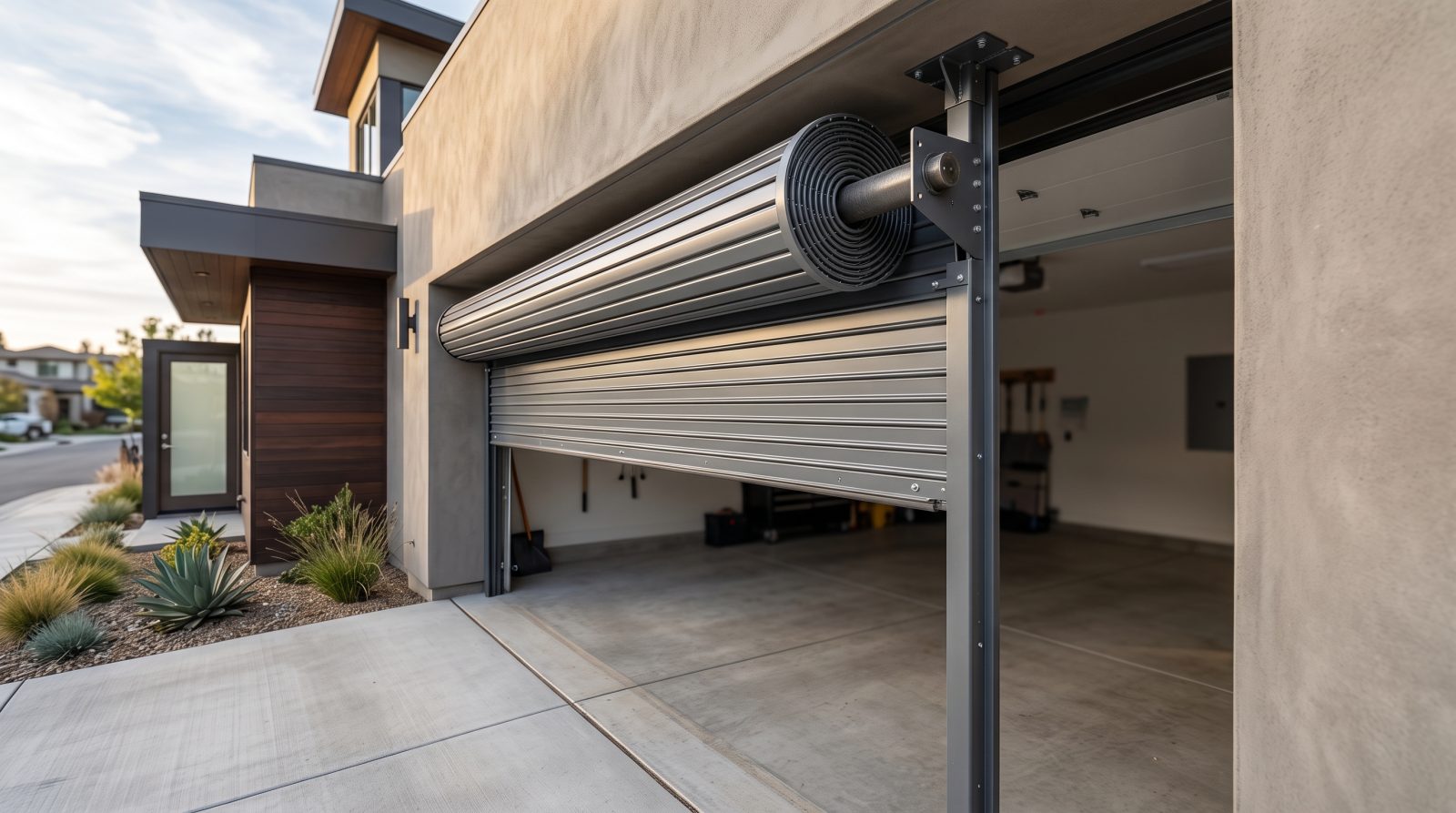
Roll-Up vs. Sectional: How a Rolling Door Actually Works
The defining feature of a roll-up door is that the door curtain coils around a horizontal barrel mounted just above the opening, rather than bending back along the ceiling like a sectional door. Picture a window roller shade scaled up to a few hundred pounds of steel: as the door opens, the slats or panels wrap tightly around that barrel; as it closes, they unspool straight down into the opening. Because everything lives in a compact roll at the top, a rolling door reclaims the ceiling and back-wall space that a sectional door's horizontal tracks would otherwise occupy. In a deep-set Bay Area garage where the owner wants to mount storage, a car lift, or a workbench against the back wall, that reclaimed volume is genuinely valuable.
There are two broad families worth understanding. Light residential and light-commercial 'roll-up' doors are usually built from hinged panels or roll-formed slats and are the type you find on smaller home garages, sheds, and many older Bay Area properties. Heavier 'rolling steel' or 'coiling' doors are built from interlocking horizontal slats of galvanized or stainless steel and are engineered for storefronts, loading docks, warehouses, parking structures, and security applications. Both share the same barrel-and-curtain principle, but the coiling versions are heavier-gauge, often fire-rated or insulated, and tensioned for hundreds of thousands of cycles of daily commercial use.
The mechanical heart of any rolling door is the spring assembly hidden inside the barrel. A torsion spring (or a set of them) is wound to counterbalance the weight of the curtain so that the door feels manageable and a motor or a person isn't fighting the door's full dead weight on every cycle. When people say a roll-up door 'feels heavy,' 'slams shut,' or 'won't stay up,' they are almost always describing a counterbalance that has drifted out of adjustment or a spring that has fatigued — not a problem with the curtain itself.
- Minimal headroom needed: ideal for low-ceiling garages, basements, and converted carriage spaces common in older SF and East Bay homes
- No horizontal ceiling track: frees up back-wall and overhead space for storage, lifts, or mechanicals
- Compact footprint at the opening: well suited to narrow Peninsula and city lots where the garage is shallow
- Strong security profile: interlocking steel slats and a coiled-up curtain resist pry attacks better than many lightweight panel doors
- Scales from small home garages to wide commercial and loading-dock openings
Where Roll-Up Doors Make Sense Across the Bay Area
The Bay Area's building stock is unusually varied, and rolling doors solve specific problems that show up again and again here. In San Francisco's older neighborhoods — the Mission, Bernal Heights, the Richmond and Sunset, Noe Valley — many homes were built with shallow ground-floor garages tucked under the living space, often with low ceilings and little room behind the opening. A sectional door's tracks may not physically fit, or they'd swallow the limited overhead space. A compact roll-up door slides neatly into that constraint, which is why we see so many of them on hilly, tight-lot city properties.
On the commercial side, rolling steel and coiling doors are everywhere the Bay Area does business. Think of the security shutters on retail frontages in downtown San Jose and Oakland, the coiling service doors on light-industrial bays in Hayward, Fremont, and South San Francisco, the loading-dock doors behind grocery and restaurant rows, and the rolling doors on self-storage facilities and parking structures throughout the Peninsula. For a business owner, a coiling door is a security decision as much as an access decision: when it's down, it presents a continuous steel face with no easy handholds, and many models accept locking and slat options chosen specifically to deter break-ins.
Climate matters too, and the Bay Area's is gentle but not neutral. We rarely fight snow load or hard freezes, but coastal fog and salt air along the ocean side of San Francisco, Pacifica, and parts of the Peninsula are quietly corrosive. Bare steel slats, exposed springs, and untreated hardware near the coast can develop rust and stiffness years before the same door would in a drier inland city like Walnut Creek or Livermore. Marine-influenced humidity is one of the top reasons a Bay Area rolling door starts binding, squealing, or coiling unevenly, and it's a factor we weigh when recommending materials and finishes for a coastal versus an inland property.
- Compact and older homes: shallow, low-clearance garages in SF's Mission, Sunset, Richmond, Bernal Heights, and similar neighborhoods
- Storefronts and retail: security shutters for ground-floor businesses in downtown San Jose, Oakland, and Berkeley
- Light industrial and warehouses: coiling service doors on bays in Hayward, Fremont, and South San Francisco
- Self-storage, parking structures, and loading docks across the Peninsula and East Bay
- Coastal properties where salt air makes finish and corrosion resistance a real design factor
The Most Common Roll-Up Door Problems We Diagnose
Rolling and coiling doors fail in recognizable patterns, and knowing the pattern usually points to the fix. The single most common serious failure is a broken or fatigued spring inside the barrel. Springs are wound under high tension and are rated for a finite number of cycles; once they weaken or snap, the counterbalance is gone and the door becomes dangerously heavy, refuses to stay open, or won't lift at all. A spring inside a tensioned barrel is the one component we strongly advise homeowners and managers not to touch — the stored energy can cause serious injury — and it's a core part of what a trained technician handles safely with the right winding tools.
The second cluster of problems is curtain and guide trouble. On a roll-up door the curtain has to track straight up into the side guides and coil evenly around the barrel. Bent slats, a dented bottom bar, debris packed into the guides, or a curtain that has shifted sideways will cause the door to bind, jam partway, coil crookedly, or come out of a guide entirely. On heavier commercial coiling doors, a forklift bump or a vehicle strike is a frequent culprit — the door may still close but no longer seal flat or run smoothly. Many of these are repairable by re-tracking the curtain, straightening or replacing individual slats, and cleaning and re-lubricating the guides, rather than replacing the whole door.
The third cluster is operator and balance issues, especially on motorized commercial units. A door that reverses unexpectedly, runs slowly, hums without moving, or trips its safety stops may have a worn motor, failing limit switches, a slipping chain or drive, or sensors and safety edges that have drifted out of spec. Underlying many of these complaints is a counterbalance that's no longer matched to the curtain weight, which makes the operator work harder than it should and accelerates wear. We diagnose the balance first, because fixing the spring tension often resolves what looks like an 'operator problem,' and rebalancing a door that's been left out of adjustment for years can meaningfully extend the life of the motor and the curtain alike.
- Broken or fatigued springs: the door feels very heavy, won't stay up, or won't lift — a high-tension repair for a technician, never a DIY job
- Bent slats or a damaged bottom bar: causes binding, crooked coiling, or a door stuck partway
- Curtain out of the guides: often from impact, debris, or an out-of-square frame; frequently re-trackable without full replacement
- Operator faults: unexpected reversing, humming, slow travel, or tripped safety stops on motorized commercial doors
- Corrosion and stiffness: rust and dry guides from coastal salt air causing squealing, grinding, or uneven roll
Repair or Replace? How to Decide
The honest answer is that most rolling doors are worth repairing, because the curtain — the most expensive part — usually outlasts the springs, hardware, and operator that move it. Springs, bearings, guides, slats, sensors, and motors are serviceable, modular components. If the curtain itself is structurally sound and the frame is true, replacing a spring, re-tracking the door, swapping a worn operator, or straightening damaged slats is almost always more economical than a full replacement, and it's the route we recommend whenever it genuinely restores safe, smooth operation.
Replacement starts to make sense when the damage is structural or cumulative. A curtain that's been crushed by a serious vehicle or forklift impact, slats that are rusted through rather than just surface-rusted, a barrel or frame that's bent out of square, or an old door that's simply mismatched to how the space is now used — for example, a thin uninsulated coiling door on a building that's since become conditioned workspace — are all cases where new equipment pays off over time. On the residential side, owners of compact Bay Area homes often upgrade when they want quieter operation, better insulation against fog and damp, or improved security, and a modern roll-up unit can deliver all three.
A few honest cost notes, all of which are typical industry ranges and estimates rather than quotes — actual pricing varies widely by region, door size and weight, material, gauge, insulation, finish, and the complexity of the job. As a rough orientation: a spring replacement on a residential-scale rolling door is commonly a few hundred dollars, while heavier multi-spring commercial coiling barrels tend to run substantially more because of the materials and the labor involved in safely winding them. Operator and motor replacements on commercial doors typically land in the high-hundreds-to-low-thousands range depending on horsepower and controls. A full new rolling or coiling door is the largest line item and scales sharply with width, height, gauge, and whether it's insulated, fire-rated, or specified for security. Because these variables swing the number so much, the only responsible figure is one tied to your specific door, opening, and site — which is exactly what an on-site assessment is for.
- Repair usually wins when: the curtain is sound, the frame is true, and the issue is springs, hardware, guides, an operator, or a few damaged slats
- Replace usually wins when: there's major impact damage, rust-through, a bent barrel or frame, or the door no longer matches the building's use
- Upgrade triggers for homes: wanting quieter operation, better insulation against fog and damp, or stronger security on a compact garage
- All costs above are typical industry ranges that vary by size, weight, material, gauge, insulation, finish, and scope — not fixed quotes
- An on-site assessment is the only way to get a number tied to your actual door and opening
Sizing, Materials & Spec Choices That Matter Here
Specifying a rolling door well is mostly about matching the door to the opening, the duty cycle, and the local environment. Width and height set the structural demands — wider commercial openings need heavier barrels and more spring capacity — but two other numbers matter just as much for Bay Area buildings: how many times a day the door cycles, and how exposed it is to coastal air. A retail shutter that opens and closes once a day has very different needs from a busy loading-dock coiling door that cycles dozens of times an hour, and under-specifying the duty rating is a reliable way to wear a door out early.
Material and finish choices carry real weight on the coast. Galvanized steel is the workhorse for most commercial coiling doors and holds up well inland, but on fog-belt and oceanfront properties, upgraded coatings, stainless options, or aluminum can be the difference between a door that ages gracefully and one that's grinding with rust in a few years. Insulation is the other quiet upgrade: insulated curtains cut noise — a genuine benefit on a compact home garage that sits directly under a bedroom — and they help moderate temperature and condensation in conditioned commercial space, which matters more in damp marine air than people expect.
Finally, think about security and controls as part of the spec, not as an afterthought. For a Bay Area storefront, slat profile, locking hardware, and whether the door presents a smooth, handhold-free face when closed are practical security decisions. For motorized commercial doors, the operator type, safety edges, photo-eyes, and manual-override provisions determine how safe and serviceable the door will be for years. We're a mobile service and we assess all of this on site, because the right spec genuinely depends on the opening, the building, and how close you are to the water — and getting it right up front is what keeps a rolling door reliable through the Bay Area's fog, damp, and daily wear.
- Match the duty rating to real usage: a once-a-day storefront shutter and a high-cycle loading-dock door are not the same spec
- Coastal corrosion: upgraded coatings, stainless, or aluminum pay off on fog-belt and oceanfront properties
- Insulation: cuts noise on compact home garages and helps with condensation in damp, conditioned commercial space
- Security spec for storefronts: slat profile, locking, and a smooth closed face are deliberate choices, not extras
- Operator and safety controls (photo-eyes, safety edges, manual override) define how safe and serviceable a motorized door stays