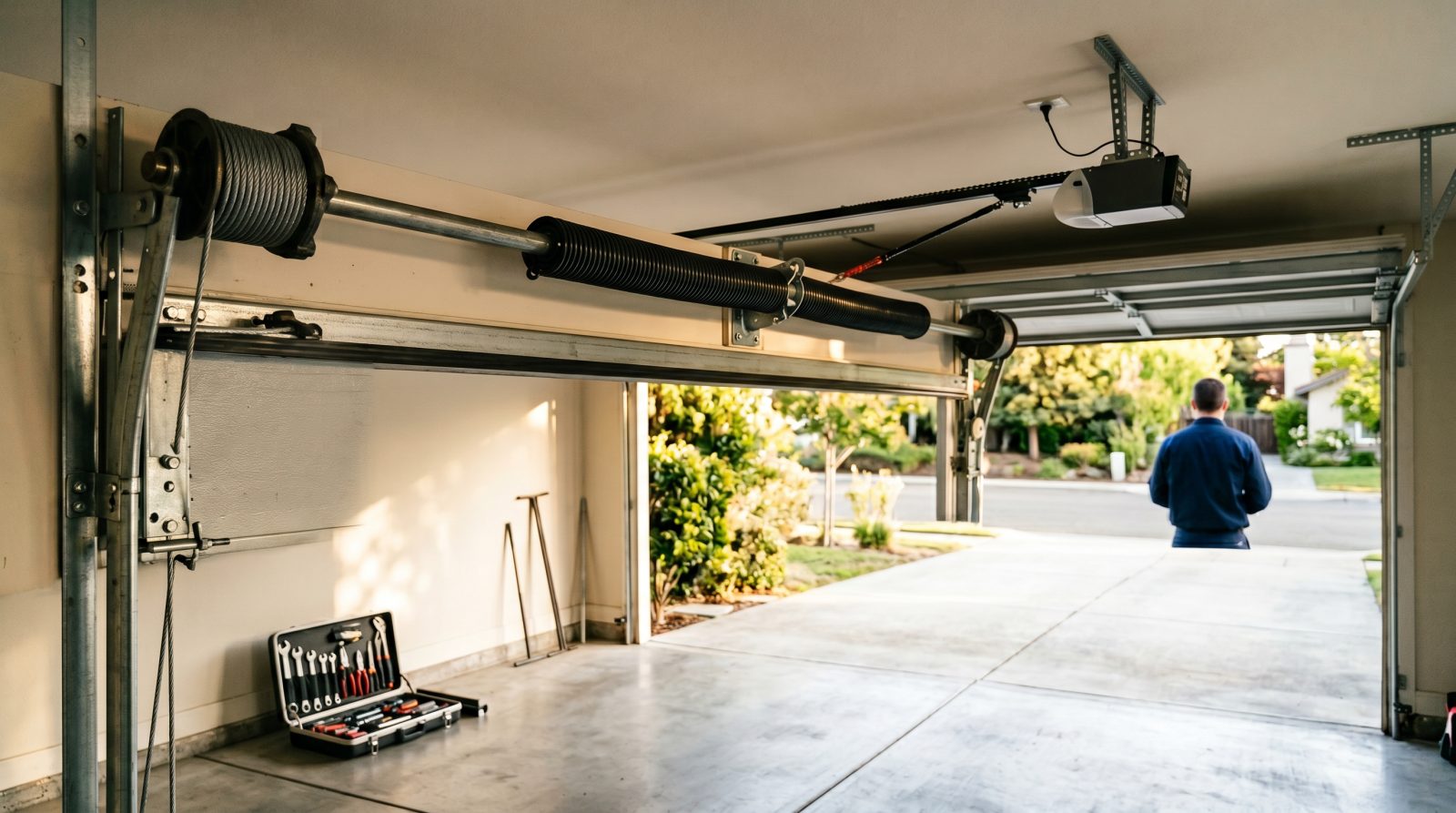
The most common garage door problems we repair
Most garage door failures trace back to a handful of components that wear out under daily use. A typical residential door cycles thousands of times over its life, and every open-and-close puts strain on the springs, cables, rollers, and opener. When one part fails, it often stresses the others, which is why a small noise ignored for a few weeks can turn into a door that will not move at all.
Knowing roughly what you are dealing with helps you describe the symptom when you call, and it helps you understand whether a door is safe to keep using in the meantime. Here are the issues we are called out for most often across the Bay Area.
- Broken torsion or extension springs — the door feels impossibly heavy, the opener strains or reverses, or you heard a loud bang like a firecracker from the garage
- Snapped or frayed cables — the door hangs crooked, one side drops faster than the other, or a cable is visibly loose and dangling
- Door off the track — rollers have jumped the rail, the door is jammed at an angle, and forcing it makes the damage worse
- Opener failure — the remote or wall button does nothing, the motor hums without moving the door, or the logic board has stopped responding
- Worn rollers and hinges — grinding, squealing, or a door that shudders and sticks as it travels
- Misaligned or blocked safety sensors — the door refuses to close and the opener light blinks, usually a quick fix many homeowners can avoid paying for
- Bent or damaged panels — often from backing into the door, which can affect both appearance and how the door seals and travels
How we diagnose the real problem in your driveway
A lot of garage door complaints sound the same but have very different causes. A door that will not open could be a broken spring, a stripped opener gear, a tripped sensor, or simply a disengaged trolley. Replacing the wrong part is how people end up paying twice, so our first job on-site is to figure out what actually failed rather than what seems obvious.
We start by disconnecting the opener and testing the door by hand. A properly balanced door should lift smoothly and stay roughly in place when stopped halfway. If it slams down or rockets up, the spring tension is wrong, which points to a spring or cable issue rather than the opener. If the door moves freely by hand but the motor will not drive it, the problem is in the opener or its drive system. This manual balance test is the single most useful check, and it separates door problems from opener problems in about a minute.
From there we inspect the springs for gaps or breaks, check cables for fraying at the drums and bottom brackets, look at roller and hinge wear, and confirm the safety sensors are aligned and clean. Because our trucks carry the parts that fail most, the majority of these diagnoses lead straight into a same-visit repair instead of a second trip.
Spring, cable, and off-track repairs — the safety-critical fixes
The counterbalance system — the springs and cables that do the heavy lifting so the opener does not have to — is under enormous tension. A torsion spring stores enough energy to seriously injure someone, which is why broken springs and cable failures are the repairs we most strongly recommend leaving to a technician with the right tools and winding bars. We see the aftermath of DIY spring jobs gone wrong, and the savings are never worth the risk.
When a spring breaks, the fix is a direct replacement, and we generally recommend matching the cycle rating to how often the door is used. On a two-spring system it is often worth replacing both at once, because they wore at the same rate and the second one is usually not far behind. Cables are replaced in matched pairs for the same reason, and we re-set the drums and balance the door so the load is even on both sides.
An off-track door needs the rollers re-seated, the track inspected for bends, and the underlying cause addressed — a door rarely jumps the track for no reason, so we check for a broken cable, a loose bracket, or an obstruction that pushed it off. Done right, the door travels straight and quiet again instead of grinding its way back off the rail a week later.
Garage door opener repair and replacement
Openers are the part homeowners interact with most, so they get blamed for a lot of problems that are not actually the opener. Before condemning a motor we rule out the simple causes: dead remote batteries, a tripped GFCI outlet, a disengaged trolley from someone pulling the red emergency release, or safety sensors knocked out of alignment by a stray broom or storage bin.
When the opener itself has failed, the question is repair versus replace. A worn drive gear, a bad capacitor, or a faulty wall console can often be repaired economically on an otherwise sound unit. But if the logic board is dead on an older opener, or the motor is at the end of its life, a new unit is usually the smarter spend — modern openers are quieter, more reliable, and add genuinely useful features like battery backup, which matters in Bay Area neighborhoods that see power outages during winter storms and grid events.
Many Bay Area homeowners also ask about smartphone control and rolling-code security. If your opener is more than a couple of decades old, upgrading is a good opportunity to gain both, along with the safety reversal features that older units predate.
Why mobile, same-day repair makes sense in the Bay Area
Being fully mobile is not just convenient — for a region as spread out and traffic-heavy as the Bay Area, it is the practical way to deliver repairs. There is no storefront to drive to and no waiting for the door to be hauled somewhere; we bring the shop to your driveway, whether you are in a San Francisco row house, a Peninsula suburb, an East Bay hillside home, or a South Bay townhouse with a tight shared driveway.
The Bay Area's mild but damp climate is hard on garage hardware in ways people underestimate. Coastal fog and marine air accelerate rust on springs, cables, and rollers, especially closer to the bay and the ocean, while inland heat dries out lubrication faster. Doors here also see heavy daily use because the garage is so often the main entrance to the home. All of this adds up to wear that arrives sooner than the manufacturer's optimistic estimates, and to repairs that are better caught early.
Because we stock the common failure parts, a large share of repairs are finished in a single same-day visit. When a door is stuck open and your home is exposed, or stuck closed with your car inside before work, fast and complete matters more than anything else.
Repair costs and what to expect
Garage door repair pricing varies widely, and an exact number sight-unseen is impossible to give honestly. The real answer is that cost depends on the part, the door, and the scope of work. As a rough industry guide, spring replacements, cable work, roller and hinge replacement, and opener repairs each sit in their own typical range, with full opener replacement and multi-panel work at the higher end. These are estimates that vary by region, door type, material, and how much has worn out around the failed part — treat them as ballparks, not quotes.
What you can count on is a clear diagnosis and an upfront estimate before any work starts, so you decide with the full picture. We will also tell you when a repair is the right call versus when a door is near the end of its life and a replacement is the better value. A well-maintained door repaired correctly should give you years of quiet, reliable service.
If your garage door is making new noises, moving unevenly, or has stopped working entirely, the safest move is to stop using it and have it looked at before a small problem becomes a dangerous one. Call for a free quote and we will come to you anywhere in the Bay Area.