Drive Type: How Your Opener Actually Moves the Door
The drive type is the single biggest decision because it determines how loud your opener is, how much maintenance it needs, and how long it tends to last. There are four common types, and each has a clear use case. The mechanism that connects the motor to the trolley (the part that pushes and pulls the door) is what separates them.
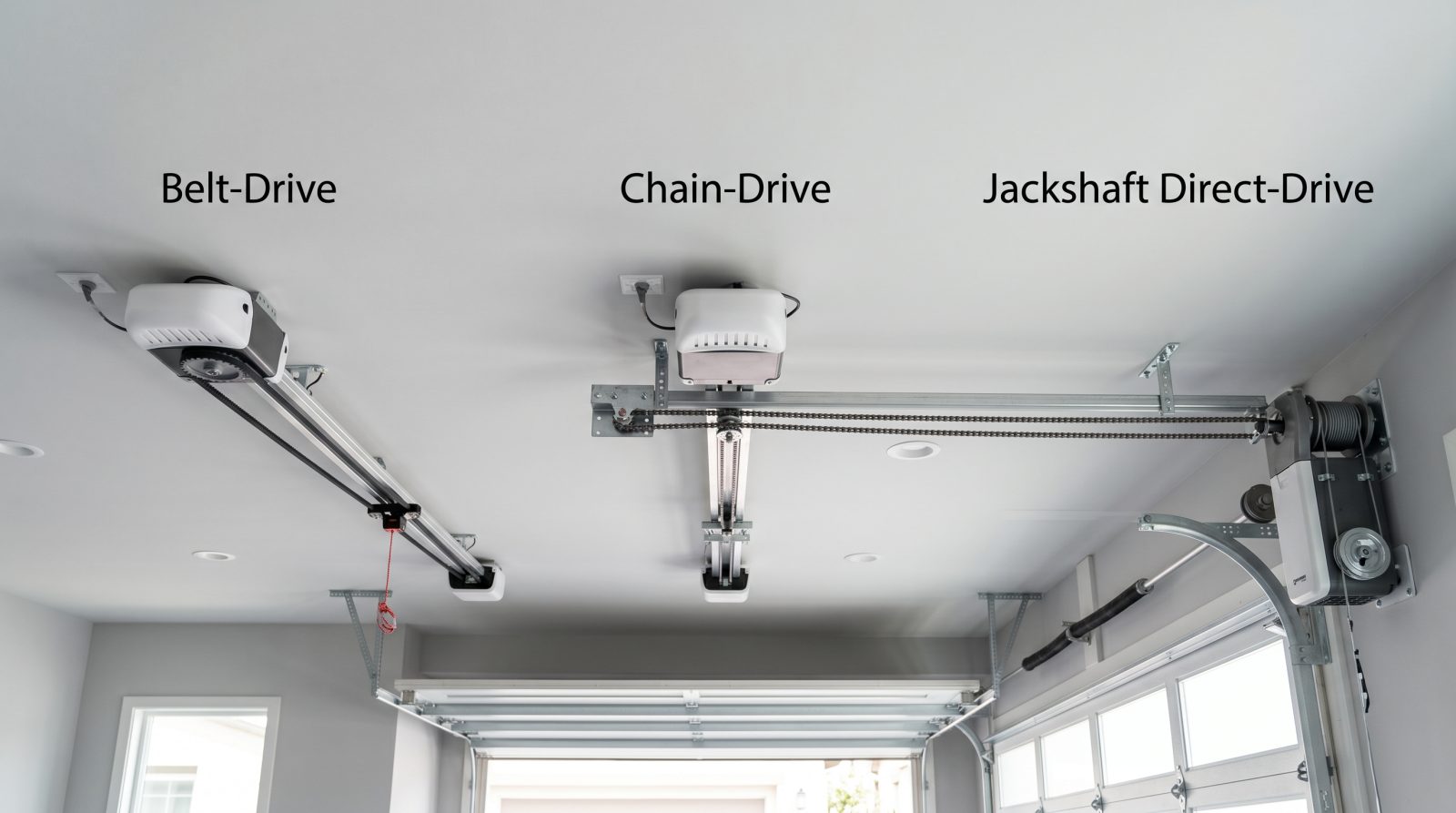
Chain-drive openers use a metal chain, much like a bicycle chain, to move the trolley. They are the most affordable and extremely durable, but they are also the loudest, producing a rattling, grinding sound and a fair amount of vibration. Belt-drive openers swap the chain for a reinforced rubber or polyurethane belt, which makes them dramatically quieter and smoother while costing a bit more. Screw-drive openers use a threaded steel rod that the trolley rides along; they have fewer moving parts and decent speed, but their performance can shift with temperature swings, which matters less in the mild Bay Area than in extreme climates. Direct-drive (also called jackshaft or wall-mount) openers either keep the motor stationary while the trolley moves along a chain inside a rail, or mount entirely on the wall beside the door and turn the torsion bar directly, freeing up your ceiling completely.
Here is how the four compare in the ways that matter day to day:
- Chain-drive: Lowest cost, very durable, but loud and vibration-heavy. Best for detached garages or shops where noise below living space is not a concern.
- Belt-drive: Quiet and smooth, mid-to-higher cost. The default recommendation for attached garages, especially with a bedroom, office, or nursery above or beside the garage.
- Screw-drive: Fewer parts and fast travel, moderate noise. A reasonable middle option that performs well in the Bay Area's stable temperatures.
- Direct-drive / wall-mount (jackshaft): Quietest of all and frees up ceiling space for storage or a car lift. Higher cost and requires a door with a properly tensioned torsion-bar setup, but ideal for low-headroom or high-ceiling garages.
Horsepower (and Why It's Really About Door Weight)
Horsepower ratings (typically 1/2, 3/4, and 1 HP, plus newer DC motors rated in equivalents or Newtons of force) tell you how much lifting power the motor can deliver. The mistake people make is buying the cheapest, lowest-rated unit to save money, or over-buying a high-HP opener thinking bigger is always better. What you actually want is a motor matched to your door's weight and size, with a little headroom so it is not straining on every cycle.
Door weight depends heavily on material and size. A standard single-car steel door is relatively light, while a double-wide door, an insulated door, or especially a solid wood or wood-overlay carriage-style door (popular on many Bay Area custom homes) can weigh several times as much. A motor that is undersized for a heavy door will run hot, work harder, and wear out years sooner. The right opener handles the door comfortably and quietly, with the springs (not the opener) doing the bulk of the lifting work.
As a practical starting framework for most homes:
- 1/2 HP class: Fine for a single, lightweight, non-insulated steel door. Often underpowered for anything heavier.
- 3/4 HP class: A strong all-around choice for most double-car steel doors and lighter insulated doors. The most common sweet spot.
- 1 HP and up (or high-force DC motors): Best for large, heavy, insulated, or wood/wood-overlay doors and oversized custom openings common on Bay Area hillside and luxury homes.
- Spring health first: An opener is only as good as the springs behind it. A well-balanced door with healthy springs lets a smaller motor work easily; a poorly balanced door makes even a powerful opener struggle. We always check door balance during an install.
Smart and Convenience Features Worth Paying For
Modern openers do far more than open and close. Some features are genuinely useful upgrades, and a few are close to essential for a Bay Area home. The trick is knowing which ones earn their place rather than just inflating the price.
Wi-Fi connectivity and a smartphone app are now standard on most mid-range and higher openers, and for good reason. Being able to check whether you left the door open after rushing out to beat the bridge traffic, or open it remotely for a delivery or a family member, is the kind of small thing you use constantly once you have it. Many smart openers also send alerts and integrate with home platforms and smart-home routines. DC motors (versus older AC motors) run quieter, start and stop more smoothly with soft-start/soft-stop, and are typically the ones that support battery backup.
Beyond connectivity, look at these features when comparing models:
- Battery backup: Highly recommended in the Bay Area, where PSPS (Public Safety Power Shutoff) events and storm outages happen. It lets the opener keep working when the power is out so you are not stuck manually wrestling the door, which matters most if you need to get a car out during an emergency.
- Built-in cameras and 2-way audio: Useful for seeing deliveries or checking the garage remotely, though optional.
- Motion-activated lighting and brighter LED lights: Practical for early-morning and evening use, and far better than the single dim bulb on old units.
- Smart-home integration: App control, voice assistants, and routines that can close the door automatically at night or alert you if it has been open too long.
- MyQ / manufacturer ecosystems: Check which platform a given opener uses and whether it works with the apps and devices you already own before you buy.
Safety Features and What Code Requires
Safety is not optional on a garage door, because the door is the largest and heaviest moving object in most homes. Since federal safety standards took effect in the early 1990s, every residential opener sold in the U.S. is required to have photo-eye sensors and an auto-reverse system, so any opener installed today meets these requirements.
Photo-eye sensors are the two small units mounted near the bottom of each side of the door track. They project an invisible beam across the opening; if anything breaks that beam while the door is closing, the door stops and reverses. This is what protects pets, children, and your car bumper. The auto-reverse mechanism also reverses the door if it contacts an object on the way down, even if the beam was not broken. If your current opener is old enough to lack photo eyes, that alone is a strong reason to replace it.
A few safety points worth understanding before you buy or replace:
- Rolling-code technology: Modern openers change the access code with every use, which prevents code-grabbing devices from capturing and replaying your signal. Older fixed-code remotes are a security risk worth retiring.
- Manual release and lock features: Quality openers include a clear manual-release cord for outages and, on some models, a vacation lock mode that disables remote opening while you are away.
- Proper sensor alignment: Misaligned or dirty photo eyes are the most common reason a door will not close. Correct installation and placement matter, which is one reason a professional install pays off.
- Don't reuse a failing safety system: If you are replacing the opener because the door reverses randomly or won't close, the issue is often the sensors, springs, or door balance rather than just the motor, and those should be diagnosed together.
Bay Area Realities That Should Shape Your Choice
The Bay Area has a few specific conditions that quietly influence which opener is the right call, and these are easy to overlook if you are shopping by spec sheet alone. Matching the opener to how and where you actually live is what separates a good purchase from a frustrating one.
Many Bay Area homes have the garage tucked directly beneath or beside living space, which is exactly the scenario where a loud chain-drive opener becomes a daily annoyance and a quiet belt-drive or wall-mount unit is worth every extra dollar. Coastal and bayside areas from the Peninsula to the East Bay shoreline carry salt-laden, humid air that is harder on metal hardware over time, so smooth-running DC motors and well-maintained components tend to hold up better. Power reliability is the other big factor: between winter storms and utility-driven PSPS shutoffs, battery backup has gone from a luxury to something many Bay Area homeowners genuinely want.
Space and home style matter too. Older homes in cities like San Francisco, Oakland, and Berkeley often have low-headroom or unusually shaped garages where a ceiling-mounted opener barely fits, making a compact wall-mount jackshaft the cleaner solution. Newer Tri-Valley and South Bay homes with tall, insulated double doors benefit from higher-force motors and smart features that fit a connected-home lifestyle. Because we are a mobile service, we bring the diagnosis to your driveway, measure your specific door and opening, and recommend an opener that fits your home rather than a one-size-fits-all box. If you are weighing your options, call for a free quote and we can talk through the right fit for your garage.