What "off track" actually means
Your garage door is not simply hanging on the wall. It is a balanced system: each panel rides on small wheels called rollers, those rollers sit inside vertical and horizontal steel tracks, and the heavy lifting is done by springs (either a torsion spring above the door or a pair of extension springs along the horizontal tracks) connected through cables. When everything is aligned and tensioned correctly, the door glides up and down with very little effort, and the opener is only nudging an already-balanced load.
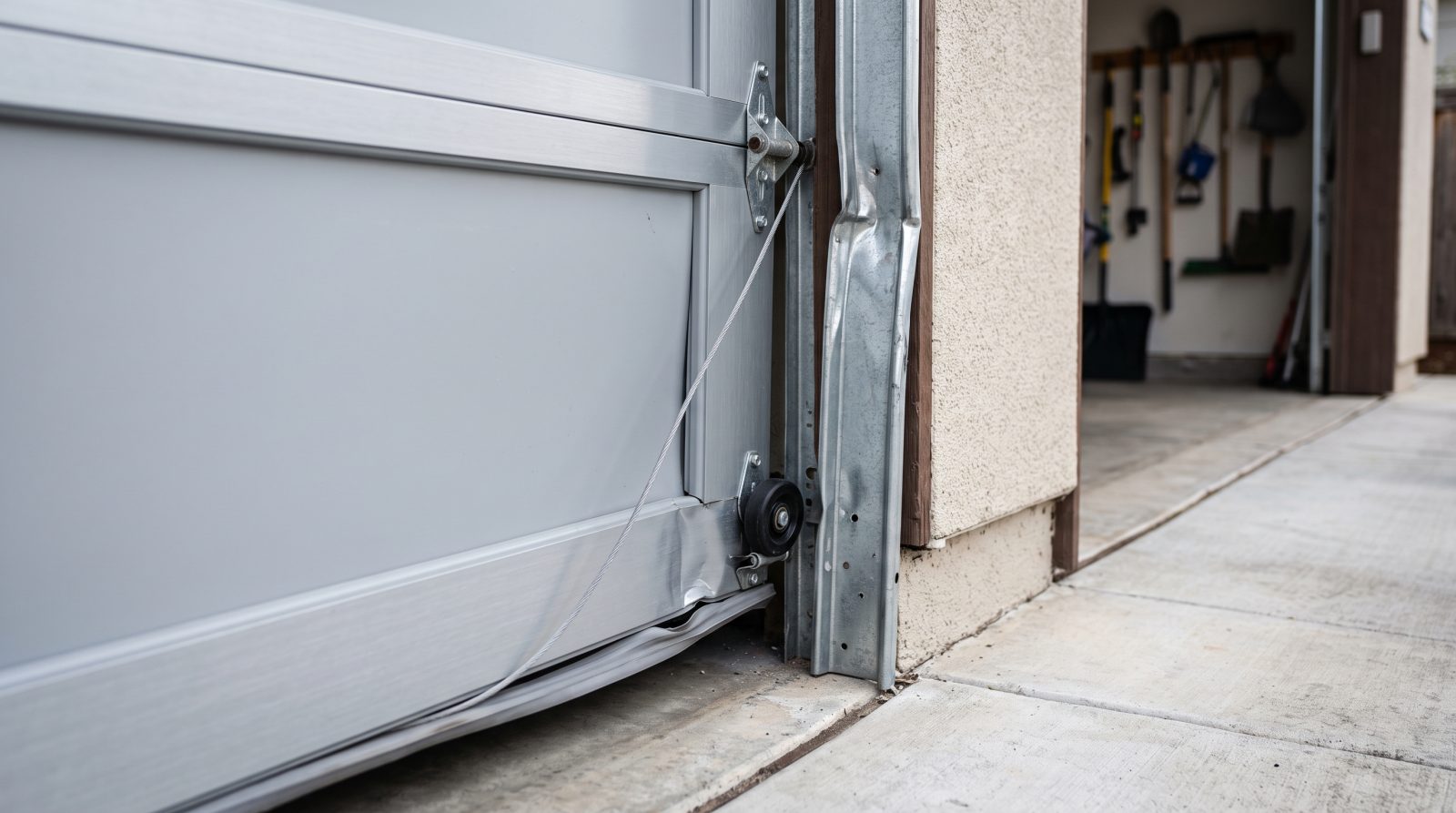
"Off track" means one or more rollers have come out of the track, or the track itself has bent or pulled loose, so the door can no longer follow its intended path. Because the panels are joined by hinges, when one section leaves the track the whole door is thrown out of square. You will often see the door tilted, a gap opening on one side, a roller sitting outside the rail, or the bottom of the door wedged against the floor or the frame. At that point the door is no longer a balanced system. It is a heavy slab being held by whatever happens to still be catching it, which is why it can feel stuck, jam halfway, or drop suddenly.
- The door looks crooked or one side hangs noticeably lower than the other
- A roller is visibly sitting outside the metal track
- The door binds, grinds, or stops partway and will not seat against the floor
- A track section is bent, flared open, or pulled away from the wall
- The opener strains, reverses, or clicks without moving the door
Why garage doors come off track in the Bay Area
Off-track doors almost always trace back to a handful of root causes, and a few of them are especially common in the Bay Area's mix of older housing stock, coastal moisture, and tight urban garages. The single most frequent trigger we see is a vehicle bumping the door, even gently, while it is partway open or while pulling in or out of a narrow San Francisco or Oakland garage. A light tap is often enough to pop a roller out or tweak the lower track.
Hardware wear is the next big one. Rollers are wear items. Older nylon or steel rollers seize, flat-spot, or lose their bearings over time, and a roller that no longer rolls freely will eventually climb out of the track. Bay Area microclimates matter here too: homes near the coast and the bay deal with persistent salt-laden moisture that rusts tracks, hinges, and roller stems, while doors in hotter inland valleys like the East Bay and South Bay see metal expansion and faster lubricant breakdown. Loose or rusted track brackets, often the result of decades-old fasteners in vintage Victorian, Eichler, or mid-century garages, let the track shift just enough for a roller to escape.
Finally, and most seriously, off-track doors are frequently a symptom of a broken cable or broken spring. When a spring fails, the cables can go slack or snap, the door loses its counterbalance, and it lurches or drops unevenly, dragging rollers out of the track. This is why an off-track door should never be treated as a purely cosmetic alignment problem. It can be the visible result of a high-tension component that has already failed.
- A vehicle or object struck the door, common in tight Bay Area garages
- Worn, seized, or flat-spotted rollers that no longer roll freely
- Rusted or corroded tracks and hardware from coastal salt air and bay moisture
- Loose or pulled-out track brackets and aging fasteners in older homes
- A broken or slack lifting cable, which lets the door drift sideways
- A broken torsion or extension spring that destroyed the door's balance
Why you should never force an off-track door
When a door is hanging crooked, the instinct is to grab it, shove the roller back in, or hit the opener button to "work it back into place." Please do not. An off-track door is one of the few household repairs where the wrong move can cause real injury, and we say that plainly because we want you safe, not to scare you into a service call.
Here is the core danger: the springs and cables on a residential garage door are under enormous tension because they exist to counterbalance a door that can weigh well over a hundred pounds. When a door is off track, you often cannot tell from the ground whether the springs and cables are intact or already failing. If you push, pull, or run the opener on a door whose balance system is compromised, the door can drop, swing, or fall, and a cable or spring under load can release suddenly. Lifting hardware that lets go does not let go gently.
Running the electric opener is its own hazard. The opener will keep trying to drag a jammed, misaligned door along a path it can no longer follow. That can bend the tracks further, rip brackets out of the wall, snap additional rollers, strip the opener gears, or wedge the door so badly that a straightforward realignment turns into a panel and hardware replacement. What might have been a quick roller-and-track fix becomes a much larger repair. The safest path is almost always to stop, leave the door where it is, keep people and cars clear of it, and have it assessed before anything else is moved.
- Disconnect the opener from the door (pull the red emergency-release cord) so it cannot try to move a jammed door
- Do not stand, walk, or park directly under a door that is hanging crooked
- Do not try to push, pull, or pry a roller back into the track by hand
- Keep children and pets out of the garage until the door is secured
- Assume the springs and cables may be compromised until a tech confirms otherwise
How a proper off-track repair is done
A correct repair starts with securing and assessing, not with shoving the door back up. When our mobile tech arrives, the first steps are to safely support the door's weight, relieve or account for spring tension, and inspect the whole system before touching the rollers. The point of that inspection is to find out why the door came off track, because realigning a door without fixing the cause just guarantees it happens again.
From there, the tech brings the panels back into square, re-seats or replaces rollers, and re-aligns or repairs the affected track sections. Bent track can sometimes be carefully straightened, but track that is badly kinked, flared, or cracked should be replaced, since a compromised track is what let the roller escape in the first place. Worn rollers get swapped out, loose brackets are re-anchored into solid material, and any rusted or failing hardware is addressed. If a cable or spring failure caused the problem, that is repaired or replaced as its own job, because it is the actual fault, the off-track door was just the symptom.
Once the door is back on its tracks, a good repair always ends with rebalancing and testing. The tech checks that the door is properly counterbalanced (a balanced door, disconnected from the opener, should hold its position roughly halfway without slamming up or down), confirms the rollers travel smoothly through the full path, verifies the safety reversal features on the opener, and lubricates the moving parts. That final balance-and-test step is what separates a door that is genuinely fixed from one that is merely back in the rail and waiting to jump out again. As a mobile service across the Bay Area, we carry common rollers, hardware, and track on the truck so most off-track repairs can be handled in a single visit.
- Secure and support the door, then account for spring tension before anything moves
- Diagnose the root cause: roller, track, bracket, cable, or spring
- Re-square the panels and re-seat or replace rollers as needed
- Straighten or replace damaged track and re-anchor loose brackets
- Repair or replace a failed cable or spring when that is the true cause
- Rebalance, lubricate, and test the door and opener safety features before finishing
Costs, timing, and what to expect
Every off-track door is a little different, so honest pricing is a range rather than a fixed number until a tech sees it. As a general guide, a straightforward realignment, reseating rollers and correcting a single bent track section, typically falls at the lower end of garage door service pricing, while jobs that involve replacing rollers, a damaged track, or a broken cable or spring cost more because they involve parts and additional labor. These are typical industry estimates only; the real figure depends on your door's size and material, how many components are damaged, and the underlying cause.
On timing, many single-door off-track repairs can be completed in one visit, and because we are mobile we come to your home or business rather than asking you to arrange anything yourself. We offer same-day service when our schedule allows. The thing that drives cost and time up is almost always waiting and forcing the door first, so the most money-saving move you can make is to stop using it the moment it goes off track. A door caught early as a simple roller-and-track issue is a far smaller job than a door that has been run on the opener until panels, brackets, and multiple rollers are damaged.
If your door is off track right now anywhere in the Bay Area, leave it where it is, keep everyone clear of it, and call for a free quote. We will assess it, explain exactly what failed and why, and put it back on track safely.