Mobile garage door service across San Mateo and the Peninsula
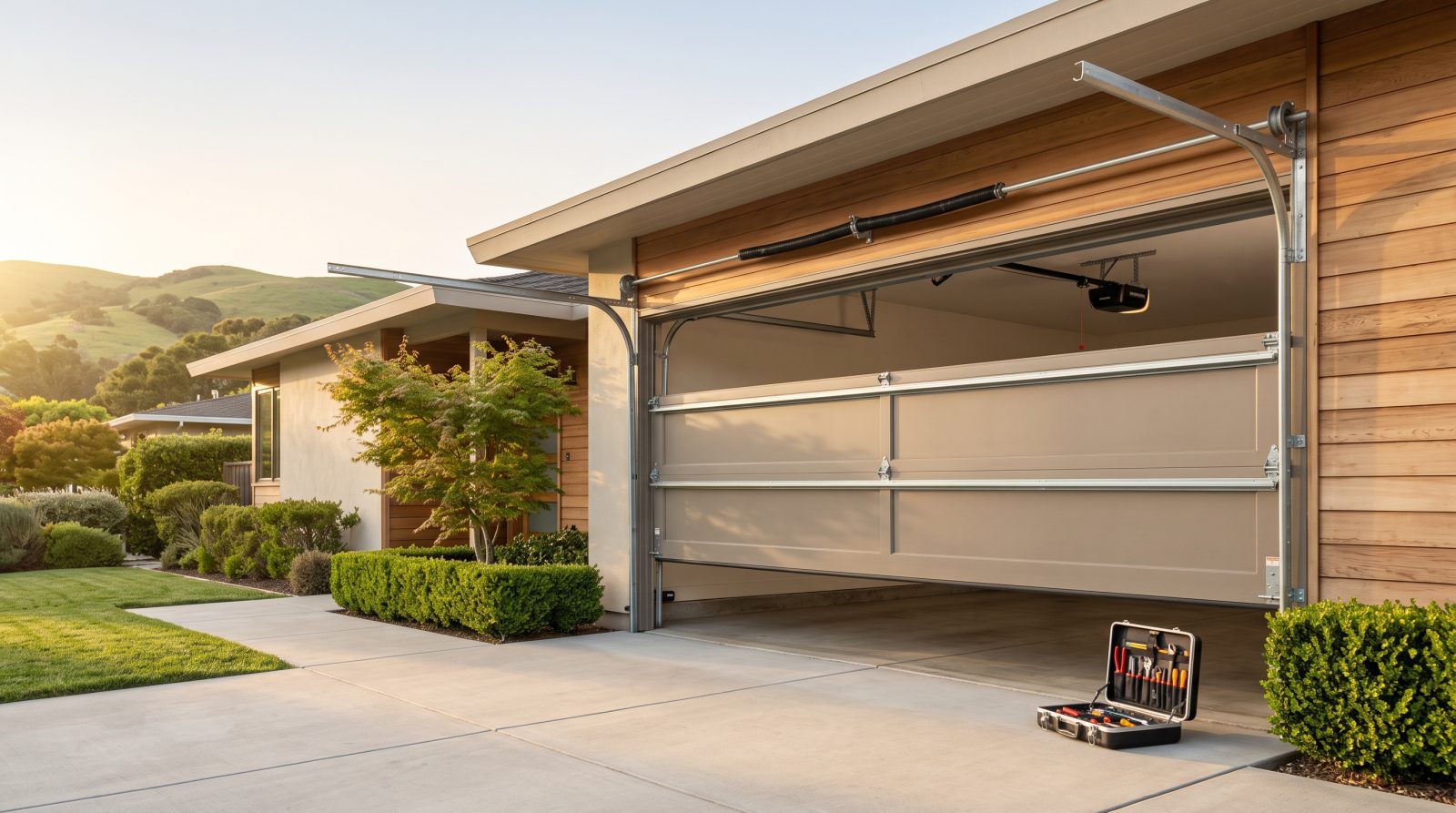
We work the way San Mateo actually lives. Most homes here have an attached garage that doubles as the main entrance, the bike room, and the place the recycling bins live, so when the door fails it's not a minor inconvenience, it's a locked-out-of-your-own-house problem. Because we're mobile, a technician arrives in a stocked vehicle with the springs, rollers, cables, openers, and hardware that cover the vast majority of repairs, which means most jobs are diagnosed and finished in a single visit right in your driveway.
Our coverage spans the full width of San Mateo, from the flats near El Camino Real and downtown over to the hillside streets climbing toward Hillsdale and Sugarloaf, and out to the waterfront neighborhoods near Coyote Point and the Bay. We also serve the surrounding Peninsula, so if you split time between a home in San Mateo and a rental in Burlingame, Foster City, or Belmont, we can handle both.
Same-day service is often available, and we'll always tell you honestly what we can and can't do on the first trip. If a door needs a custom panel or a special-order section, we'll get the working parts safe and operational that day and schedule the rest once the material arrives.
- Broken and worn torsion or extension spring replacement
- Garage door opener repair, replacement, and smart-opener upgrades
- Off-track doors, frayed or snapped cables, and worn rollers
- Noisy door tune-ups, balancing, and safety reversal testing
- Full door and section replacement, including insulated steel doors
- Residential and light-commercial doors for San Mateo businesses
How the San Mateo climate and housing stock affect your door
San Mateo's location on the Bay side of the Peninsula gives it a milder, foggier microclimate than communities further inland. That marine layer matters more than people expect. Damp, salt-tinged air is hard on the steel components inside a garage door system, and over the years it speeds up corrosion on springs, cables, hinges, and the small rollers and bearings that keep everything moving quietly. A spring that might last a long time in a dry inland climate can fatigue and fail sooner here, often with no warning.
The housing itself tells the story too. A lot of San Mateo's established neighborhoods, like Hayward Park, Beresford, and the streets around Aragon, are full of single-story ranches and post-war homes built when a two-car garage and a single wide wooden or early steel door were standard. Many of those original doors are now decades old, heavier than modern doors, and paired with openers that predate today's safety and security features. On the other end, the redeveloped areas around Bay Meadows and the Bay Meadows Station district bring newer construction with modern sectional doors and Wi-Fi openers that have their own quirks.
Hillside homes toward Hillsdale and the western edge of town add another wrinkle: sloped driveways and tight, angled garage approaches put extra stress on the door's tracks and alignment every time it cycles. Knowing which of these situations you're in helps us diagnose the real cause instead of just treating the symptom.
- Marine-air corrosion that shortens the life of springs, cables, and rollers
- Original wood and early-steel doors on older ranch homes that have grown heavy and unbalanced
- Aging openers on long-time homes that lack modern safety sensors and rolling-code security
- Newer smart openers near Bay Meadows that need correct setup and firmware-aware troubleshooting
- Track and alignment wear on hillside homes with steep or angled driveways
The most common repairs we see in San Mateo homes
By a wide margin, the number one emergency call is a broken spring. Torsion springs, mounted on the shaft above the door, and extension springs, running alongside the tracks, do the heavy lifting of counterbalancing a door that can weigh well over a hundred pounds. They're under enormous tension, and when one breaks you'll usually hear a loud bang and then find the door either won't open or feels impossibly heavy. This is a repair to leave to a technician: a spring under load can cause serious injury, and the springs need to be sized and wound correctly for your specific door.
Opener problems are the second big category. Sometimes it's a simple fix like realigning the photo-eye safety sensors near the floor, which get bumped by bikes, bins, and storage and then refuse to let the door close. Other times the logic board, motor, or drive gear has worn out, especially on units that have been cycling several times a day for fifteen or twenty years. When an opener is at the end of its life, replacing it is usually smarter than chasing repeated repairs, and a modern unit adds quieter operation, battery backup, and phone control.
Off-track doors, frayed cables, flattened rollers, and broken hinges round out the everyday list. These often start as a small noise or a slight catch and get ignored until the door jams or comes off its track entirely. Catching them early is almost always cheaper and safer than waiting for a full failure, which is why we include a quick safety check on every visit.
- Broken torsion or extension springs — the most common urgent call
- Opener failures, dead logic boards, and misaligned safety sensors
- Doors off the track from worn rollers or a hard impact
- Frayed or snapped lift cables, which can leave the door dangerously unbalanced
- Worn rollers, hinges, and bearings causing grinding, rattling, or jerky travel
Repair, tune-up, or replace? Making the right call
Not every problem means a new door, and not every old door is worth saving with another repair. As a rule of thumb, if the panels are solid and the door is reasonably current, replacing a worn component like a spring set, cables, or rollers is the sensible, cost-effective path. A door that has simply gotten loud or sluggish often just needs a tune-up: lubrication, rebalancing, fresh rollers, and tightened hardware can bring it back to near-new operation for a fraction of replacement.
Replacement starts to make sense when several things stack up at once. If you have a heavy original wood door from the home's early days that's warped or splitting, an opener that's already on its last legs, and corrosion across the hardware, you're better off putting your money into one modern insulated door rather than repeatedly patching an aging system. A new insulated steel door also helps with San Mateo's cool, damp mornings by buffering the temperature in attached garages that are used as gyms, offices, or playrooms.
We'll give you an honest assessment either way. If a repair is clearly the right move, we'll tell you, and if replacement genuinely saves you money over the next few years, we'll explain why. As for cost, garage door work varies widely with the type of door, the spring system, the opener, and the scope of the job. Treat any figure you see online as a typical industry range and an estimate only, not a fixed quote — the accurate number comes from looking at your actual door, which we'll do as part of a free on-site quote.
- Repair: solid, fairly modern door with a single failed part like a spring, cable, or roller
- Tune-up: a working door that's gotten loud, slow, or slightly unbalanced
- Replace: aging heavy door plus a failing opener plus widespread corrosion
- Upgrade pick: insulated steel doors help moderate temperature in garages used as living space
- All pricing is a region-dependent estimate; the real number comes from an on-site look
Safety, security, and what to do when your door fails
A garage door is the largest and heaviest moving object in most homes, so a few safety habits matter. If your door slams down fast, won't stay open on its own, or doesn't reverse when something is under it, stop using it and call for service. Those are signs the spring balance or auto-reverse system isn't working correctly, and a door that can't catch itself is a real hazard to kids, pets, and cars. Never try to remove or adjust a torsion spring yourself — the stored tension is genuinely dangerous.
Security is the other half of the equation. In an attached-garage home, that door is often the easiest way into the house, so an opener with old fixed-code remotes or no rolling-code encryption is worth upgrading. Modern openers pair secure codes with phone alerts, so you'll know if the door was left open after you've pulled out toward the 101 or El Camino on your way to work.
If you're stuck right now, here's the short version: if the door is jammed, off its track, or hanging crooked, don't force it — forcing a misaligned door can bend panels or snap a cable. If a car is trapped inside, most openers have a manual release cord, but only use it if the door isn't under spring failure. When in doubt, leave it alone and reach out. We're happy to talk you through making the situation safe until a technician arrives, and we'll come to you anywhere in San Mateo. Call for a free quote and we'll get your door working safely again.
- Stop using a door that won't reverse, slams shut, or won't hold its position
- Never adjust or remove a torsion spring yourself — the tension can cause serious injury
- Upgrade old fixed-code openers to rolling-code, phone-alert security
- Don't force a jammed or off-track door; you can turn a cheap fix into an expensive one
- Call for a free on-site quote and we'll bring the parts to your San Mateo driveway